ELASTIC NETTING
 AUTOMATION
 BONE PROTECTION
Automatic Meat Stuffing Machines: A Buyer’s Guide to Industrial Efficiency
Can an industrial facility justify a capital investment that pays for itself in under six months? Integrating an automatic meat stuffing machine is no longer just about volume; it's a strategic response to UK production operator salaries now reaching up to £38,000. You likely face constant pressure from inconsistent product weights and operational lag caused by manual tube changes. These inefficiencies erode margins in an increasingly competitive market. This guide shows how to evaluate high-speed stuffing automation to cut labour costs, minimise downtime, and achieve rapid ROI in large-scale meat processing. We'll examine the technical specifications required to exceed 1,000 units per hour while reducing operator headcount from seven to just one. This ensures your facility maintains peak industrial efficiency through proven mechanical reliability.
Key Takeaways
- Identify essential selection criteria for industrial equipment, prioritising a baseline throughput of 1,000 units per hour to ensure large-scale operational viability.
- Evaluate the efficiency gains of an automatic meat stuffing machine, comparing single and double configurations that can exceed 1,200 netted joints per hour.
- Analyse the financial benefits of full automation, including the potential to reduce operator headcount and achieve a return on investment in under 12 months.
- Maintain rigorous hygiene standards and simplify food safety audits by selecting stainless-steel machinery designed for tool-free cleaning and maintenance.
Key Selection Criteria for Industrial Meat Stuffing Equipment
Selecting an automatic meat stuffing machine requires a focus on measurable output and technical compatibility. For industrial viability, we use a baseline throughput of 1,000 units per hour to compare stuffing systems. Our systems can accommodate a range from 75mm to 250mm diameters.
Analysing Labour Efficiency and Throughput
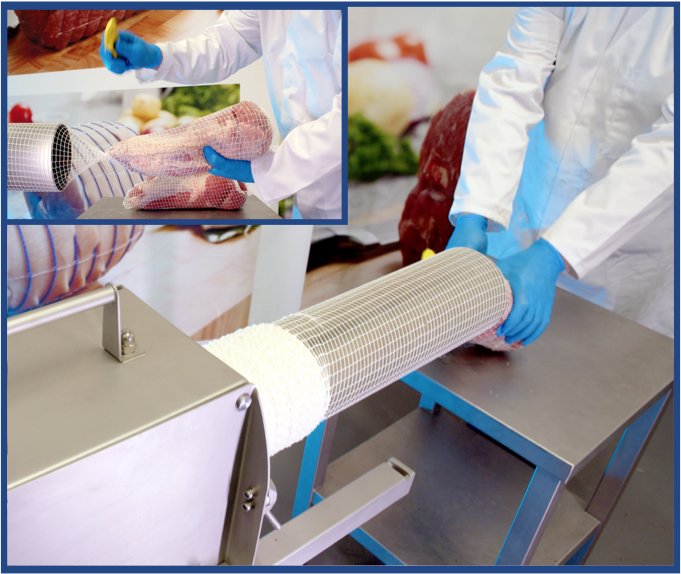
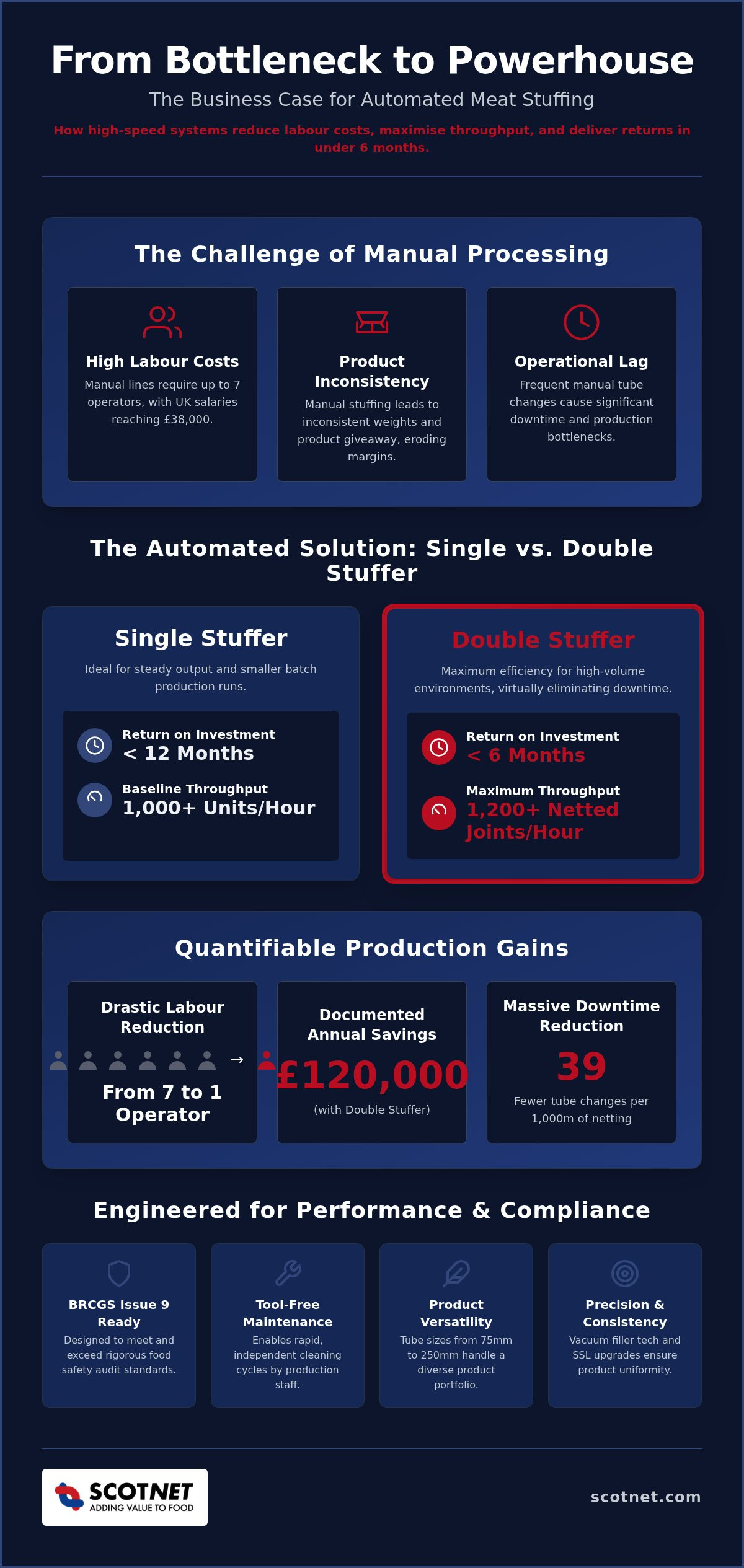
Labour costs represent a primary operational cost in meat processing. To achieve our baseline output of 1000 joints per hour, manual stuffing lines often require up to seven operators to maintain production pace. The different automated systems from Scotnet can reduce this headcount significantly, often to as few as one to three personnel depending on the system. Transitioning to automated stuffing solutions offers immediate efficiency gains. Double stuffer technology is particularly effective here. It allows two operators to load the chamber and cut the net. At the same time, the autoloader effortlessly reloads additional tubes. By optimising these workflows, facilities can achieve documented annual savings of £120,000 for double-stuffer setups. This shift transforms the stuffing line from a labour-intensive bottleneck into a streamlined, high-speed asset capable of exceeding 1,200 netted joints per hour. The result is a more predictable production schedule and a drastically reduced cost per unit.
Comparing Single vs. Double Stuffer Configurations
The choice between a Single Stuffer and a Double Stuffer determines the maximum throughput potential of a processing facility. While single configurations provide a steady output for smaller batches, a double automatic meat stuffing machine can exceed 1,200 netted joints per hour. The DS1200AC3 Autocut achieves this through full automation, requiring only one operator to maintain the entire line. This model uses precision sensors to cut closer to the meat, creating cleaner tails and significantly reducing material waste. It's a system designed for high-volume environments where finished appearance is vital, and every gram of saved product contributes to the bottom line.
The Selectable Stroke Length (SSL) replicates a manual stuffing line, where operators shape the joint. This feature lets the team set the machine to specific product dimensions. This focus on technical precision ensures that high-speed production doesn't come at the expense of product quality or safety standards.
Remote Monitoring and Predictive Maintenance
Digital integration allows for real-time oversight of production metrics. Cloud-based diagnostics enable remote issue resolution, bypassing the cost and delay of physical engineering visits. Operators can track performance through intuitive touchscreen HMI interfaces. Additionally, the Automatic Water Injection (AWI) upgrade is available to reduce friction with dry joints like uninjected pork.
Frequently Asked Questions
How much labour can an automatic meat stuffing machine save?
An automatic meat stuffing machine significantly reduces operator headcount by transitioning from manual processes to streamlined automation. A manual stuffing line producing 1000 joints per hour typically requires seven personnel. In contrast, fully automated configurations such as the DS1200AC3 Autocut require only one operator. This shift can reduce annual operator costs from £315,000 to £45,000 for an operation running a shift and a half.
What is the typical ROI for a double-stuffer machine?
High-speed double-stuffer machines deliver a rapid return on investment through substantial labour and material savings. For a double-stuffer configuration, ROI is typically achieved in under six months. This is supported by documented annual savings of £120,000. These financial gains result from increased throughput and a reduction in tube changes, which can be up to 39 fewer changes per 1,000m of netting.
Can automatic stuffers handle different tube sizes for varied products?
Yes, industrial stuffing equipment is designed to handle a wide range of product sizes. Standard DS1200 series models accommodate tube sizes from 75mm to 200mm. For facilities requiring larger dimensions, the DS1200P8EH extended-head variant extends this capability to 250mm. This flexibility lets processors manage multiple SKUs on a single line without separate machinery for different joint diameters.
What are the maintenance requirements for high-speed stuffing equipment?
Modern automatic meat stuffing machine designs prioritise minimal maintenance through tool-free cleaning access and durable stainless-steel construction. Daily sanitation doesn't require on-site engineers, as the quick-clean design allows production staff to access internal components easily. Additionally, secure cloud-based diagnostics enable remote issue resolution. This approach minimises downtime and reduces the need for expensive physical engineering visits, ensuring consistent production uptime.
Article by
Gordon Wicklow
Gordon Wicklow is Managing Director of the Scobie & Junor Group, a family-owned Scottish business that has served the food and meat-processing industry for more than a century. A graduate of the University of St Andrews, Gordon has been a director of Scobie & Junor since 1998.
He leads the Group’s work across the UK and Ireland, helping food manufacturers add value through innovative ingredients, specialist packaging, elastic meat netting and automated processing machinery. Drawing on extensive industry experience and technical knowledge, Gordon champions practical innovation, operational efficiency and close customer collaboration—from developing new flavours and formulations to improving production yields, presentation and consistency.
Under his leadership, Scobie & Junor continues to combine more than 100 years of experience with modern manufacturing, new-product development and market insight, providing food processors and butchers with solutions designed for today’s evolving consumer and production demands.