ELASTIC NETTING
 AUTOMATION
 BONE PROTECTION

Automatic Meat Tying Machine: A Technical Guide
With UK food manufacturing vacancy rates persisting at 5.0%, over 54% of processors now cite labour availability as the primary driver for adopting end-of-line automation. You're likely aware that manual stringing has become an unsustainable bottleneck, compromising both throughput and visual consistency. Inconsistent tension and frequent downtime for twine changeovers directly erode your operational margins.
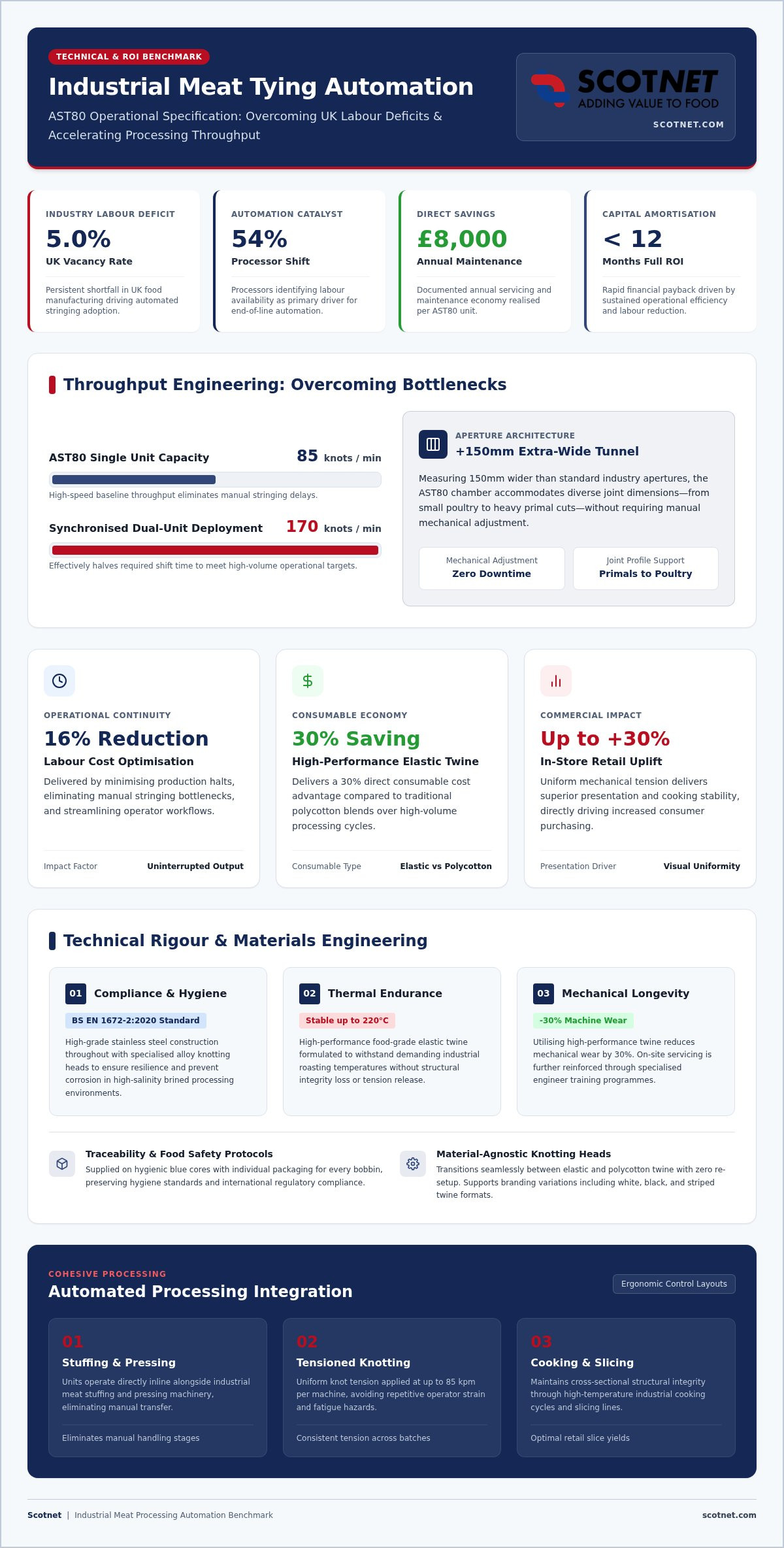
This technical guide shows how an industrial automatic tying machine used in meat facilities, specifically the AST80, achieves 85 knots per minute while delivering annual maintenance savings of £8,000 per unit. You'll discover how to optimise processing efficiency and reduce labour costs through advanced engineering.
Key Takeaways
- Discover how the AST80 optimises production throughput by consistently achieving 85 knots per minute.
- Quantify the financial benefits of automation, including documented annual maintenance savings of £8,000 per machine.
- Identify how an automatic tying machine used in meat processors can deliver a 16% reduction in labour costs by minimising production halts.
- Understand the technical advantages of using roast-stable elastic twine up to 220°C to ensure consistent, food-safe product presentation.
The Role of Automation in Industrial Meat Tying
Modern industrial meat processing operations have shifted focus toward full automation to address the inherent inefficiencies of manual stringing. Implementing an automatic tying machine that meat facilities can rely on ensures uniform tension across every joint, from small poultry to heavy primal cuts.
Overcoming Throughput Bottlenecks with High-Speed Tying
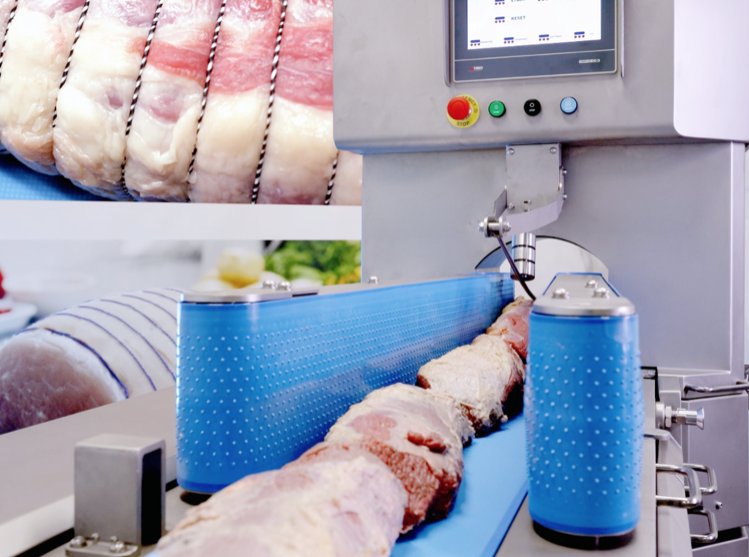
Manual tying remains a primary production bottleneck, yet the AST80 delivers a market-leading throughput of 85 knots per minute. This automatic tying machine meat solution is supported by an extra-wide tunnel, measuring 150mm wider than standard industry apertures, which accommodates diverse joint sizes without the need for mechanical adjustment. By deploying two synchronised machines, a facility can achieve a 170kpm output, effectively halving the required shift time to meet high-volume daily targets.
Technical Versatility: Handling Various Joints and Twine Types
Industrial agility depends on a machine's ability to transition between product lines without extensive retooling. The AST80's ease of changing twine colours and separating loops makes it ideal for demanding operations. This flexibility ensures retail presentation remains high without sacrificing throughput.
Processing salted or brined meats introduces specific technical challenges. High-salinity environments can rapidly corrode standard machinery and cause twine failure if materials aren't rated appropriately. High-grade stainless steel construction and specialised knotting heads ensure long-term reliability in these conditions.
Material Compatibility: From Elastic to Polycotton Twine
Our **automatic tying machine **supports seamless transitions between elastic and polycotton materials. Traceability is maintained through hygienic blue cores and individual wrapping for each bobbin, ensuring compliance with international food safety standards. High-performance elastic twine provides a 30% cost advantage compared to traditional polycotton blends, significantly reducing consumable expenditure over high-volume cycles.
Evaluating Operational Efficiency and Maintenance ROI
High-throughput operations frequently achieve a full return on investment (ROI) in under 12 months. This outcome is primarily driven by substantial labour-cost reductions and a 16% decrease in production halts. Beyond immediate labour savings, professional presentation is a critical commercial driver. Data indicates that professionally presented joints can increase in-store sales by up to 30%, making the knot's visual quality as important as application speed.
Long-term operational stability relies on technical support and preventative care. Engineer training packages let on-site teams perform routine servicing, reducing reliance on external technicians. High-performance consumables are equally vital; for example, high-performance twine reduces machine wear by 30%. Facilities don't just require speed; they also prioritise tailored service packages for their tying equipment.
Optimise your production line with the AST80 Automatic Tying Machine to achieve superior efficiency in your facility.
Frequently Asked Questions
How many knots per minute can an automatic tying machine achieve?
An automatic tying machine such as the AST80 delivers a market-leading throughput of 85 knots per minute. This high-speed performance lets facilities maintain a consistent output of 170 knots per minute with two synchronised units. These speeds eliminate the bottlenecks common with manual stringing while ensuring uniform tension across every joint for a professional retail presentation.
Is automatic tying twine safe for high-temperature roasting?
Yes, high-performance elastic twine is specifically engineered for thermal stability up to 220°C. This temperature rating keeps the twine oven-safe during industrial roasting without compromising structural integrity or food safety. Each cone features a hygienic blue core and individual wrapping to maintain traceability and comply with global food processing standards on high-volume production lines.
What maintenance do an industrial meat tying machine require?
The AST80's maintenance is streamlined through a modular knotting head that can be removed in minutes with two bolts. This design prioritises uptime and lets on-site teams perform routine servicing after engineer training. These engineering controls effectively reduce technical downtime and long-term operational expenditure.
Can one tying machine handle different types of meat and joint sizes?
The AST80 features an extra-wide tunnel, 150mm wider than the industry standard, to accommodate diverse joint sizes and meat types. It functions as a versatile automatic tying machine that facilities can use for poultry, pork, or beef without manual re-setup. The system is colour-agnostic and material-agnostic; it handles elastic or polycotton twines across various branding requirements seamlessly.
Article by
Gordon Wicklow
Gordon Wicklow is Managing Director of the Scobie & Junor Group, a family-owned Scottish business that has served the food and meat-processing industry for more than a century. A graduate of the University of St Andrews, Gordon has been a director of Scobie & Junor since 1998.
He leads the Group’s work across the UK and Ireland, helping food manufacturers add value through innovative ingredients, specialist packaging, elastic meat netting and automated processing machinery. Drawing on extensive industry experience and technical knowledge, Gordon champions practical innovation, operational efficiency and close customer collaboration—from developing new flavours and formulations to improving production yields, presentation and consistency.
Under his leadership, Scobie & Junor continues to combine more than 100 years of experience with modern manufacturing, new-product development and market insight, providing food processors and butchers with solutions designed for today’s evolving consumer and production demands.