ELASTIC NETTING
 AUTOMATION
 BONE PROTECTION
Bone Guard Vacuum Packaging: Industrial Protection and Efficiency Guide
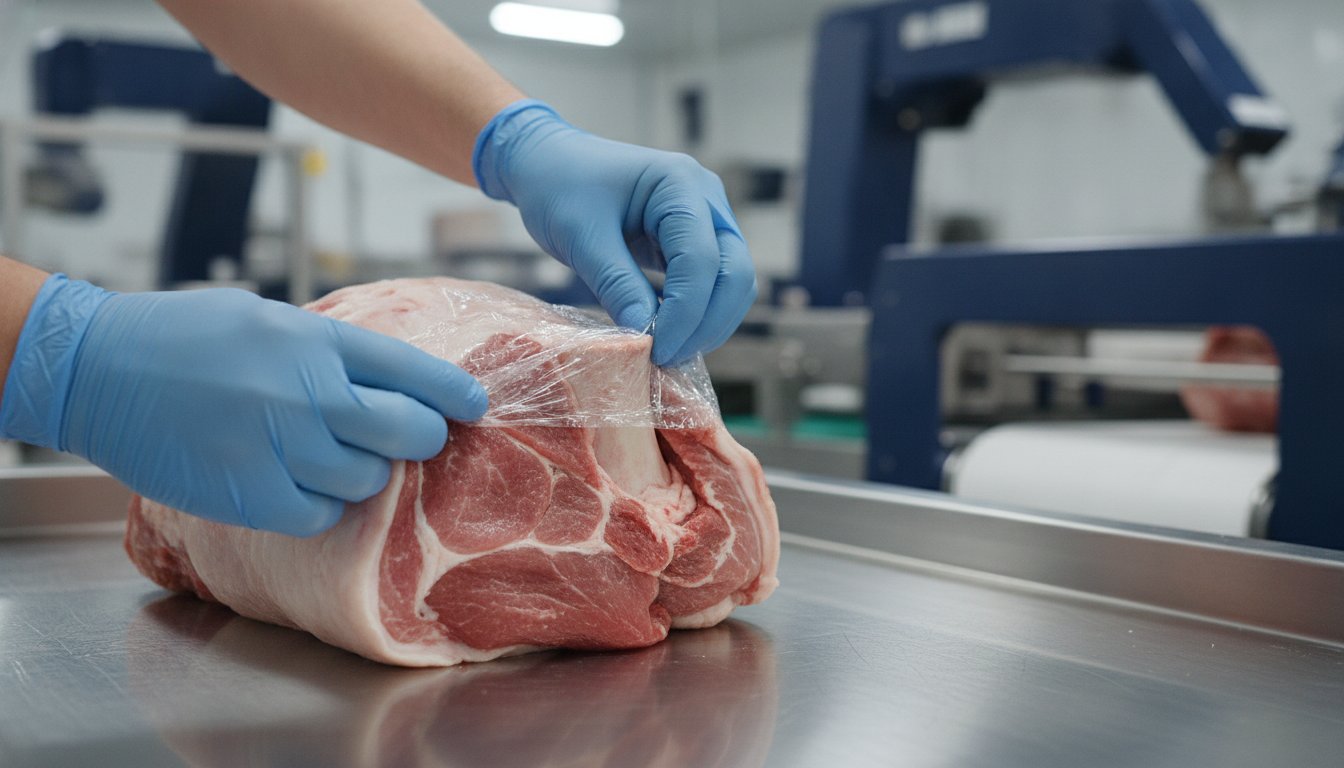
Can a single material prevent vacuum pack leakers while simultaneously cutting packaging waste by over 50%? For meat processors handling bone-in joints, puncture-related failures are a persistent threat to operational margins and sustainability targets. High leaker rates don't just result in product spoilage; they also increase the financial burden of the UK Plastic Packaging Tax, which reached £228.82 per tonne in April 2026.
This guide details how technical bone guard vacuum packaging materials provide the necessary puncture resistance to maintain seal integrity without excessive bulk. You'll learn how to implement high-strength sheets and recyclable pre-formed caps to reduce puncture rates to under 1%. We provide a technical overview of material performance, waste reduction metrics, and industrial application strategies for modern food processing environments.
Key Takeaways
- Identify the technical requirements for bone-in protection.
- Compare the operational efficiency of perforated rolls against pre-formed Rack and Shank Caps for specific high-volume meat processing applications.
- Discover how transitioning to thermoformed bone protection can reduce individual pack material weight by over 50%.
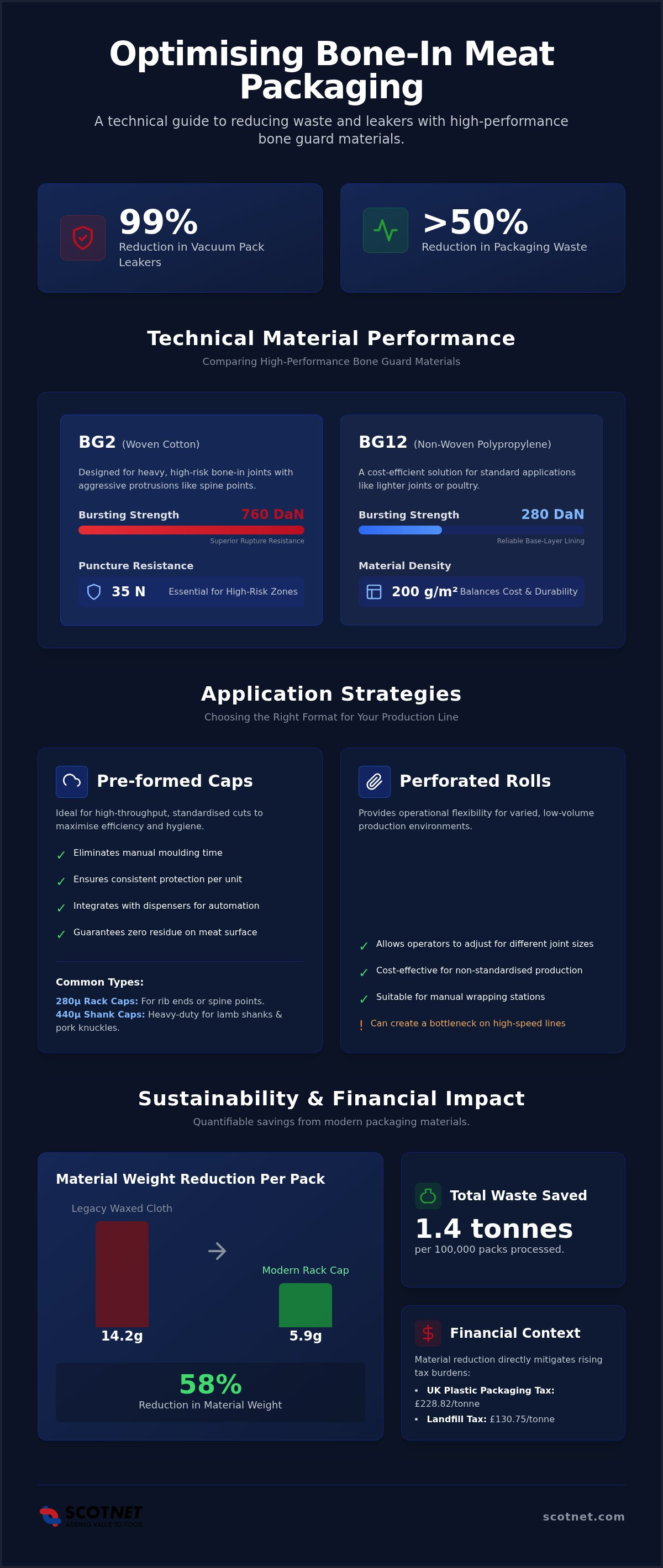
- Quantify the sustainability impact of modern protection sheets and caps, which can save up to 1.4 tonnes of waste for every 100,000 units processed.
Technical Specifications of High-Performance Bone Guard Materials
Industrial protection for bone-in meat relies on specific mechanical properties to ensure seal integrity. High-performance bone protection vacuum packaging depends on two primary metrics: puncture resistance, measured in Newtons (N), and bursting strength. Bursting strength is the pressure a material can withstand before rupture, measured in Decanewtons (DaN). These metrics determine whether a material can withstand the stresses of the vacuum packing, where atmospheric pressure forces the film against sharp bone protrusions.
Application Strategies: Pre-formed Caps vs Perforated Rolls
Manual wrapping using perforated rolls provides essential flexibility for varied, low-volume production environments. This method allows operators to adjust protection for different joint sizes on the fly. However, manual application often creates an operational bottleneck in high-speed lines. For standardised cuts, the efficiency of thermalformed bone protection increases significantly through the use of pre-formed components like Rack Caps and Shank Caps.
Clean removal is a critical performance indicator for industrial protection materials. High-quality sheets and caps are engineered to leave zero residue on the meat surface, ensuring product quality and appearance remain uncompromised for the end consumer.
Optimising High-Throughput Lines with Shank and Rack Caps
Pre-formed 280µ Rack Caps eliminate the time-intensive task of manual moulding around rib ends or spine points. For more aggressive protrusions like lamb shanks or pork knuckles, 440µ Shank Caps provide a standardised, heavy-duty barrier. Implementing dedicated shank-cap dispensers in large-scale facilities reduces manual handling time while improving hygiene standards. This systematic approach ensures that every unit receives consistent protection without slowing down the primary packaging line, effectively standardising the protection across the entire production run.
Sustainability and Operational ROI: Reducing Packaging Waste
Traditional waxed cloth presents a significant financial and environmental burden for high-volume meat processors. Its excessive material weight and general lack of recyclability in modern food-grade streams increase operational costs and waste disposal levies. Transitioning to modern **thermoformed bone protection **allows for precision protection that reduces the volume of non-recyclable material entering the waste stream.
Material savings are quantifiable through targeted product selection. For instance, switching from waxed cloth to a 280µ Rack Cap reduces material weight from 14.2g to 5.9g per unit. This 58% weight reduction directly lowers the carbon footprint of the packaging process and mitigates the impact of the UK Plastic Packaging Tax.
Protect your product and your profits with Scotnet's industrial bone guard solutions. Optimising your packaging workflow today establishes a foundation for long-term commercial and environmental success.
Frequently Asked Questions
How does bone protection reduce vacuum pack leakers?
Bone guard materials act as a heavy-duty mechanical barrier between sharp bone protrusions and the primary packaging film. During the vacuum-drawing process, atmospheric pressure forces the plastic film tightly against the product. Without protection, jagged bone ends easily puncture the film. By applying high-performance bone guard vacuum packaging, processors create a buffer that absorbs this pressure, maintaining seal integrity throughout the supply chain.
Are bone guard materials recyclable?
Recyclability depends on the specific material format. Pre-formed Rack and Shank Caps are fully recyclable, offering a sustainable solution for high-throughput lines. Waxed cloth is not recyclable at all.
Can bone protection reduce overall packaging weight?
Substantial weight reduction is achievable by transitioning from traditional waxed cloth to precision-engineered bone guard vacuum packaging. Switching to a 280µ Rack Cap reduces individual pack material weight from 14.2g to 5.9g. This 58% reduction significantly lowers total waste volumes. For large-scale operations, this shift can divert 1.4 tonnes of material from disposal streams for every 100,000 packs processed, improving operational ROI.
Article by
Gordon Wicklow
Gordon Wicklow is Managing Director of the Scobie & Junor Group, a family-owned Scottish business that has served the food and meat-processing industry for more than a century. A graduate of the University of St Andrews, Gordon has been a director of Scobie & Junor since 1998.
He leads the Group’s work across the UK and Ireland, helping food manufacturers add value through innovative ingredients, specialist packaging, elastic meat netting and automated processing machinery. Drawing on extensive industry experience and technical knowledge, Gordon champions practical innovation, operational efficiency and close customer collaboration—from developing new flavours and formulations to improving production yields, presentation and consistency.
Under his leadership, Scobie & Junor continues to combine more than 100 years of experience with modern manufacturing, new-product development and market insight, providing food processors and butchers with solutions designed for today’s evolving consumer and production demands.