ELASTIC NETTING
 AUTOMATION
 BONE PROTECTION
Elastic Netting in the Meat Industry: A Technical Guide to Retail Presentation
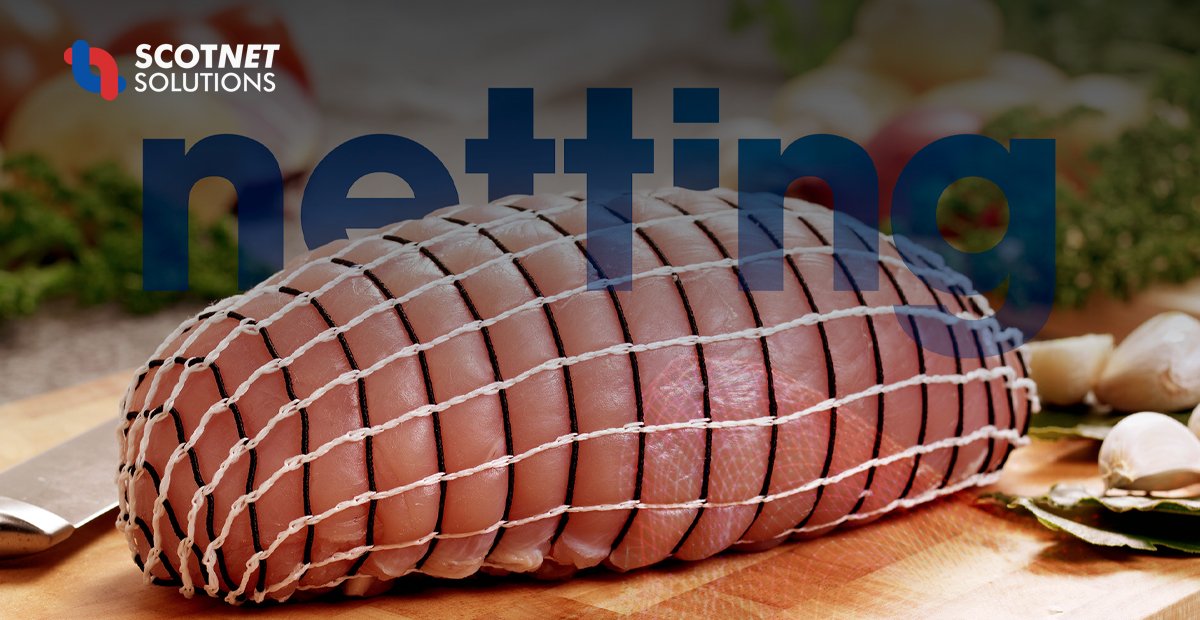
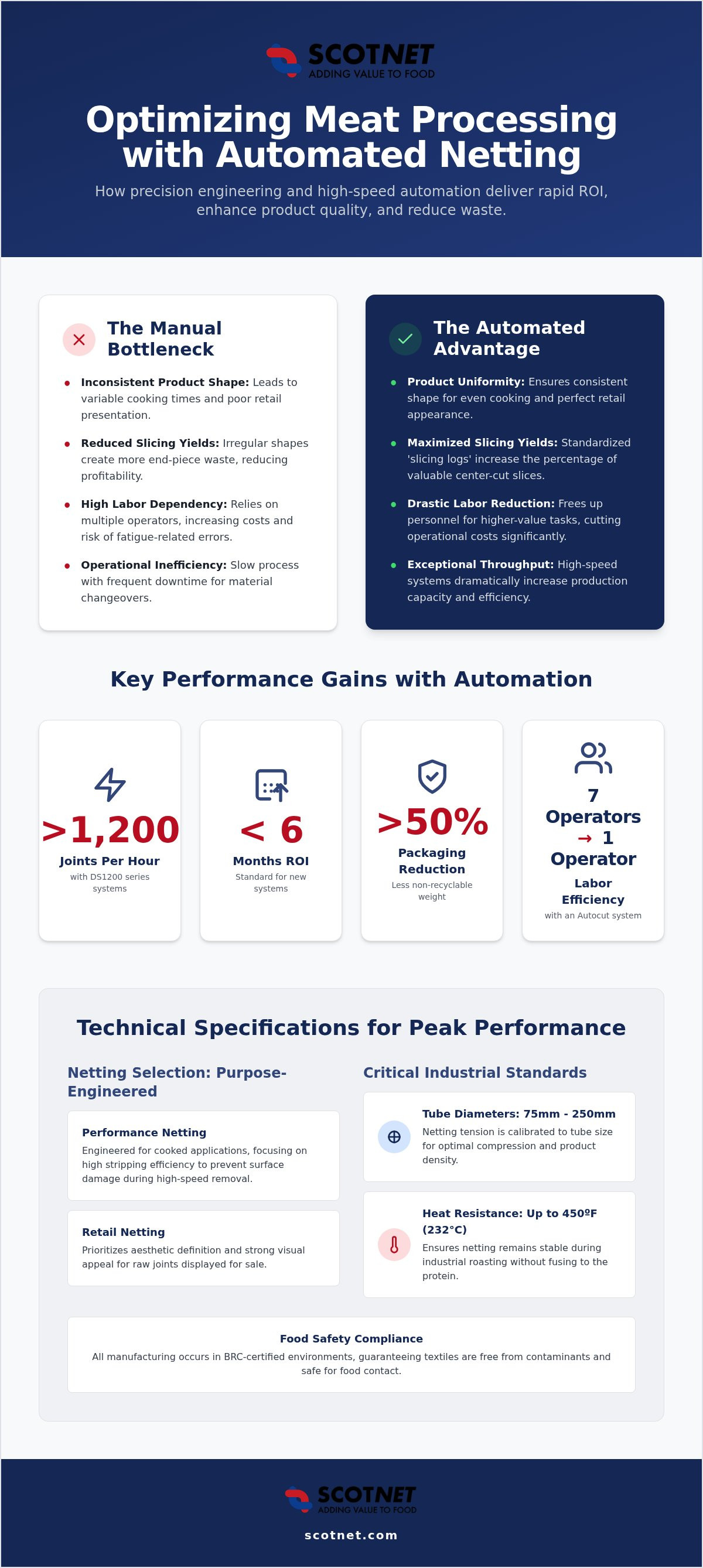
An ROI of under six months is now achievable for processors transitioning from manual netting to high-speed automated systems. In the competitive elastic-netting meat industry, reliance on manual labour often results in inconsistent product shapes and reduced on-shelf appearance. This technical guide explains how precision-engineered netting systems, combined with the netting itself, can optimise production efficiency and enhance retail presentation. We'll examine the integration of high-speed machinery, such as the DS1200 series, which consistently achieves over 1,200 joints per hour with two operators.
Key Takeaways
- Transitioning from manual netting to an automated process ensures product uniformity and enhances retail presentation across netting systems.
- Training the production teams and eliminating errors in the production process sets the groundwork for optimising appearance.
- Working with the marketing teams to then enhance the visual of the finished product.
- Integrating automated double-stuffer systems allows processors to achieve throughputs exceeding 1,200 joints per hour with minimal operator intervention.
The Role of Elastic Netting in the Global Food Industry
Technical textiles within the elastic netting for the meat industry are engineered for radial compression and thermal stability. Unlike simple packaging, these materials function as precision tools that ensure product uniformity and consistent heat transfer. On top of this, the correct application of the netting and the introduction of colours can enhance its functionality, making it part of the whole sales process rather than just a functional part of the cooking process. Then the transition from manual netting to high-speed stuffing addresses the need for both aesthetic retail appearance and industrial efficiency. While hand-stuffing is slow and inconsistent, automated stuffing has advanced in recent years, with the latest machines addressing spring-back and spring-out.
Technical Specifications: Selecting Netting for Retail Presentation
The start of the netting process always involves loading the net onto the horn or tube. Doing this without damaging the net is vital for a good retail appearance. Next is ensuring the horn or tube is the best fit for the product. If it's too small, the meat may have to be forced through the tube, increasing the likelihood of spring-out. If the tube or horn is too large, then a visually similar but different problem is introduced, which is spring-back. Then, as with all processes, consistency is the next most important part to tackle. Only when there is consistency can problems be identified and eliminated. This is where our automation systems start to play a really key role.
Performance vs Retail Netting
Processors must distinguish between performance netting and retail netting. Performance variants are engineered for cooked applications, focusing on high stripping efficiency to minimise surface damage during high-speed removal. Retail netting prioritises aesthetic definition and visual appeal for raw joints. To optimise your process, consider how technical netting specifications align with your specific machinery and output goals.
Adding Colour to Enhance Presentation
Having worked with processors to achieve consistent, correct production techniques, we now have the foundation to further enhance the visual appearance. Brand values can be enhanced, and product messaging reinforced. For years, we have seen trays, labels, and sleeves being used to deliver colour messaging. Now let's include netting in the overall package to make the finished product's appearance even more impactful.
Making the experience at home
Many retailers imagine their work is done when the product leaves their shelf. However, in reality, our work is far from done at this stage. On the shelf, the net is there to enhance the appearance of the joint. At home, the net is mainly there to make the joint as cylindrical as possible, which helps with even cooking. It also holds the meat together so that it forms an easy-to-slice single piece, which is what is expected on the dinner plate. This is where another common issue can be solved. Too little pressure can cause the joint to fall apart, but too much can make the net more difficult to remove, so finding a balance between power and stripping ease is important. Adjusting the number of squares can help here too. In some cases, where there is a large variation in diameter, multiple tube sizes may have to be used.
Frequently Asked Questions
How do I calculate the correct netting size for a specific meat joint diameter?
Netting size selection is primarily based on the stuffing tube diameter. Industrial standards typically align with tube diameters from 75mm to 250mm. To achieve correct radial compression, the flat width of the netting must be precisely matched to the tube circumference. Selecting the wrong size results in either product deformation or netting failure. Consult a technical specification chart to ensure the chosen netting provides optimal tension.
Can elastic netting be used in high-temperature industrial roasting?
Technical elastic netting is manufactured to endure industrial roasting environments with temperatures reaching 220ºC. These materials are designed to retain their structural integrity and elastic memory throughout the thermal cycle. Always confirm that materials comply with BRC safety standards for high-heat food contact applications.
What are the labour savings associated with switching to an automated stuffing machine?
Automating the netting process transforms labour requirements by consolidating multiple manual steps into a single machine-driven operation. A single operator can manage a high-speed stuffing line that previously required several employees for hand-netting. This reduction in manual intervention lowers the risk of repetitive strain injuries while significantly decreasing the labour cost per joint. It ensures consistent output regardless of staffing levels.
Article by
Gordon Wicklow
Gordon Wicklow is Managing Director of the Scobie & Junor Group, a family-owned Scottish business that has served the food and meat-processing industry for more than a century. A graduate of the University of St Andrews, Gordon has been a director of Scobie & Junor since 1998.
He leads the Group’s work across the UK and Ireland, helping food manufacturers add value through innovative ingredients, specialist packaging, elastic meat netting and automated processing machinery. Drawing on extensive industry experience and technical knowledge, Gordon champions practical innovation, operational efficiency and close customer collaboration—from developing new flavours and formulations to improving production yields, presentation and consistency.
Under his leadership, Scobie & Junor continues to combine more than 100 years of experience with modern manufacturing, new-product development and market insight, providing food processors and butchers with solutions designed for today’s evolving consumer and production demands.