ELASTIC NETTING
 AUTOMATION
 BONE PROTECTION
Industrial Cooked Meat Netting: A Technical Guide to Yield and Efficiency
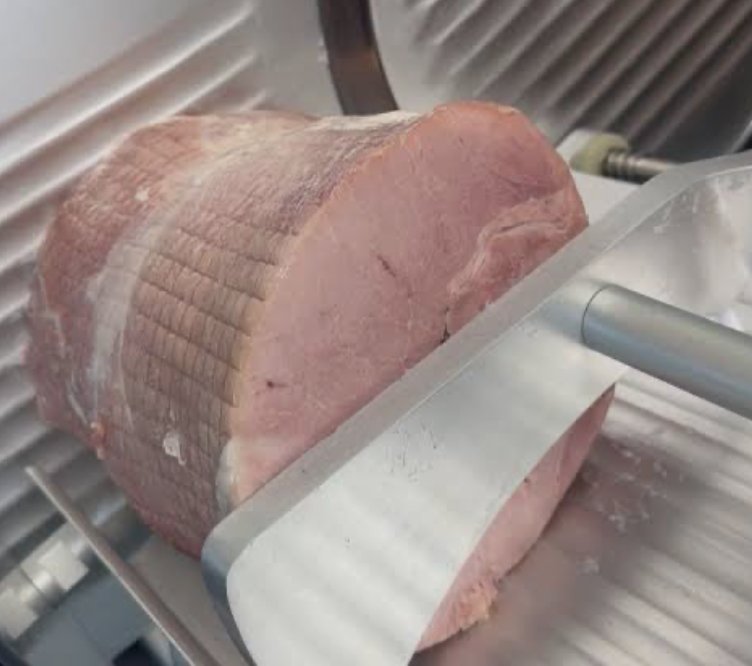
A production run's profitability often hinges on a single millimetre of diameter variance or a fraction of a per cent in cooking loss. While netting might seem like a secondary packaging concern, it's a precision engineering component that dictates the financial viability of your entire cooking, stripping and slicing process. Industrial processors frequently struggle with excess cooking loss and the costly downtime caused by netting sticking to the product during stripping. These inefficiencies don't just slow down the line; they directly erode margins and lead to inconsistent product shapes that increase slicing waste.
Selecting the right cooked meat netting, or Performance Netting, requires an understanding of material tension and thermal stability. This technical guide analyses the specifications necessary to optimise industrial cooking yields and improve stripping efficiency. We'll explore how tailored netting solutions, when paired with automated stuffing and pressing machinery, create the product uniformity required for modern high-speed slicing lines. From navigating the 2026 EU regulations on food contact materials to implementing smart technology for better traceability, we provide the technical foundation needed for consistent manufacturing success.
Key Takeaways
- Understand the correlation between radial pressure and protein binding to ensure product uniformity in restructured meat applications.
- Learn to evaluate the "Power" rating of elastic netting to optimise tension for specific cooking cycles and minimise cooking loss.
- Review material science requirements for heat stability and compliance with 2026 global food safety regulations regarding BPA and PFAS.
- Identify technical specifications for cooked meat netting that facilitate "Easy-Strip" performance and reduce surface damage during high-speed production.
- Explore the efficiency gains achieved by using high-capacity netting bobbins with automated stuffing and pressing equipment.
The Functional Role of Netting in Cooked Meat Processing
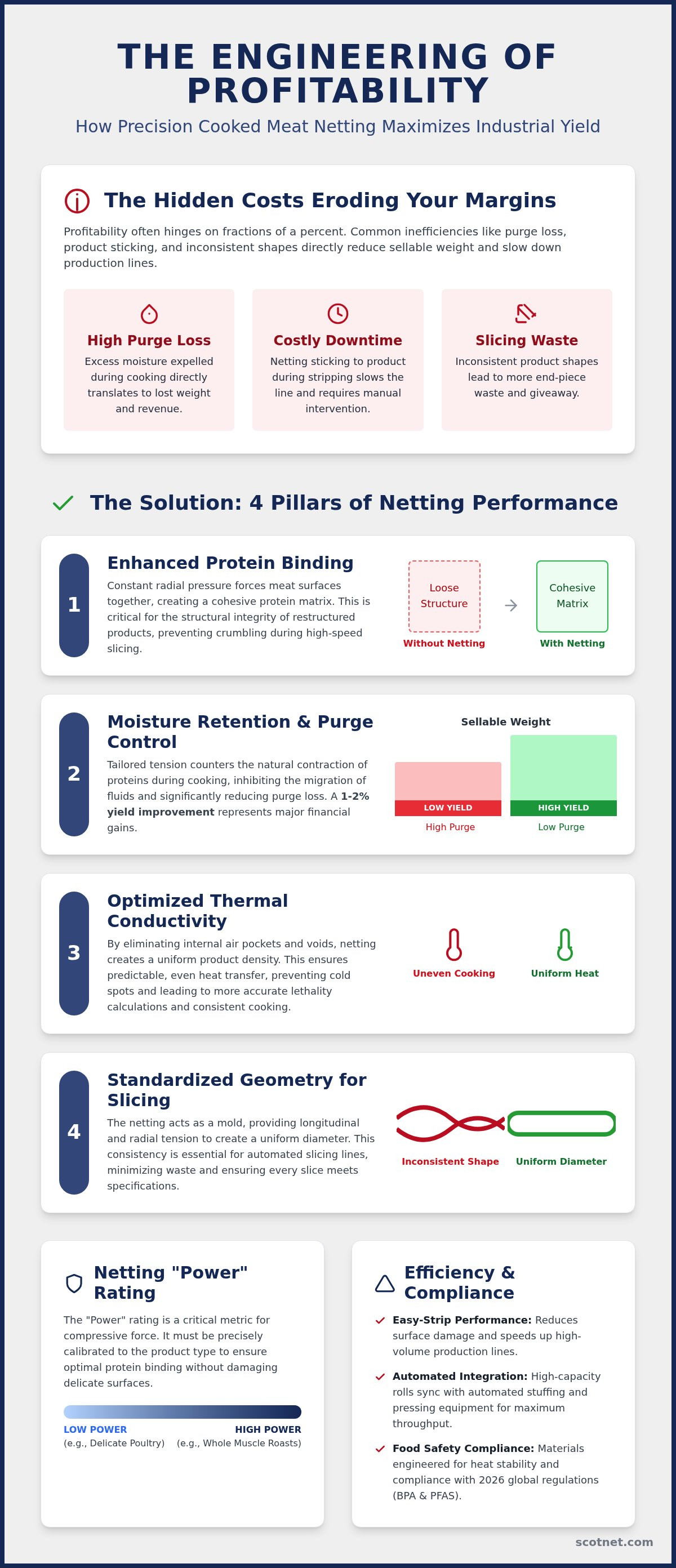
Industrial cooked meat netting, or performance netting, serves as a specialised compressive processing tool rather than a mere packaging material. Its primary function is to apply constant radial pressure throughout the thermal processing cycle. This mechanical force is essential for the structural integrity of restructured products. In the production of processed meat, the compression facilitated by the netting enhances protein extraction and subsequent binding. By forcing meat surfaces into intimate contact, the netting promotes the formation of a cohesive protein matrix. This bond is vital for products that must withstand the mechanical stresses of high-speed slicing without crumbling or separating.
Beyond structural binding, consistent compression optimises thermal conductivity. Air pockets and internal voids act as insulators, potentially leading to uneven cooking or cold spots within the product core. Applying the correct cooked meat netting or Performance Netting reduces these voids, ensuring a uniform density that allows for predictable heat transfer. This leads to more accurate lethality calculations and consistent sensory profiles across entire production batches. It's a mechanical solution to a thermodynamic challenge, ensuring the product reaches the target internal temperature efficiently.
Moisture Retention and Cook Loss Control
Consistent radial tension minimises the release of extracellular water during the cooking process. When meat proteins denature under heat, they naturally contract and expel moisture. Tailored netting counters this contraction by maintaining a tight, pressurised environment. This pressure inhibits the migration of fluids to the product surface, effectively reducing purge loss. In high-volume ham production, even a 1% to 2% yield improvement represents a significant increase in sellable weight and operational profitability. Maintaining product integrity in high-humidity cooking environments requires this precise balance of tension and material elasticity to keep moisture locked within the protein structure.
Standardising Product Geometry for Slicing
Automated slicing lines require high levels of dimensional consistency to minimise giveaway and maximise throughput. Industrial-grade performance netting provides the necessary longitudinal and radial tension to achieve a uniform diameter across the entire length of the product. This standardisation reduces slicing waste and ensures every slice meets retail specifications for weight and shape. Whether the requirement is a traditional cylindrical profile or a specific D-shape, the netting acts as a mould that holds the meat in position during the protein-setting phase. This structural stability is critical for maintaining high yields in automated slicing environments where even minor variances lead to rejected units.
Technical Specifications: Meshor Square Size, Tension, and Power
Industrial cooked meat or performance netting is defined by its "Power" rating, a metric representing the compressive force exerted on the product surface. Unlike basic diameter measurements, the power rating determines the success of the protein-binding phase. High-power netting is engineered for large muscle groups, such as whole-muscle or multi-muscle pork joints, where significant radial pressure is required to maintain structural integrity. Conversely, lower power ratings are utilised for delicate poultry applications to prevent surface tearing.
The physics of the cooking cycle involves both radial and longitudinal contraction. As the meat proteins denature and moisture is released, the netting must provide continuous tension to close internal voids. This requires a precise calibration between the netting's elastic modulus and the stuffing pressure of the machinery. If the stuffing pressure exceeds the netting's elastic limit, the product will lose its intended shape, leading to slicing inefficiencies. Compliance with guidelines from the Food Safety and Inspection Service (FSIS) ensures that these processing methods meet rigorous safety standards while maintaining product quality.
Selecting cooked meat or performance netting with the correct mesh or square count involves balancing aesthetic requirements with functional performance. Dense mesh patterns provide a smoother surface finish and better containment for small meat pieces or emulsions. Wide mesh patterns create the traditional "bubbled" appearance associated with premium deli hams. For processors looking to optimise these variables, utilising tailored elastic netting ensures the tension profile matches the specific requirements of the production line.
The Impact of Netting Tension on Final Yield
Optimal yield is achieved when netting tension is matched to the specific species and product type. For pork applications, moderate power prevents excessive purge while ensuring the fat cap remains adhered to the lean muscle. Over-tensioning results in product deformation and potential excess cook loss or purge. Under-tensioning is equally detrimental; it allows for excessive extracellular water release and the formation of air pockets, which directly reduces slicing yields and shelf life.
Material Science: Heat Stability and Food Safety Compliance
Material selection for cooked meat netting is a critical determinant of performance during industrial cooking cycles. Elastic netting typically utilises a food-grade rubber core wrapped in high-tenacity polyester. Polyester is preferred over traditional cotton blends due to its superior thermal stability and hydrophobic properties. It doesn't absorb moisture, which prevents the netting from becoming a reservoir for bacteria or losing structural integrity during steam-heavy cooking cycles. Research supported by the American Meat Science Association (AMSA) emphasises that the thermal behaviour of processing materials directly influences the final texture and safety of processed proteins.
Performance requirements vary significantly between high-temperature roasting and steam cooking. In roasting environments exceeding 180°C, the material must resist melting and chemical degradation. Low-linting synthetic fibres are essential in these high-heat scenarios to prevent filament shedding onto the product surface. This technical requirement ensures a clean production environment and maintains the aesthetic standards required for premium retail presentation. Choosing materials with high heat resistance prevents the netting from fusing to the meat surface, a common cause of stripping failure.
Thermal Resistance and Elastic Recovery
The elastic modulus of industrial netting is susceptible to degradation under prolonged heat exposure. High-quality elastomers are engineered to resist "relaxation," a phenomenon where the netting loses its compressive force mid-cycle. If the netting relaxes, the product's internal density decreases, leading to the air pockets and voids mentioned in previous sections. Industrial smokehouses utilise rigorous testing protocols to verify that the netting maintains its initial tension throughout an eight-hour cooking cycle. This recovery capability is vital for maintaining the uniform diameter necessary for automated slicing.
Food Safety and Traceability Standards
Compliance with global food contact standards, including FDA and EFSA regulations, is non-negotiable for modern processors. Migration limits for food-grade elastomers must be strictly verified to ensure no chemical transfer occurs during high-heat processing. Modern manufacturing facilities prioritise BRC and ISO certifications to maintain a transparent supply chain. Comprehensive traceability systems allow processors to link specific cooked meat netting rolls to production batches, providing a necessary layer of safety during quality audits.
Optimising Stripping Efficiency and Slicing Yields
Stripping efficiency is a critical KPI in industrial meat processing. While the primary role of cooked meat netting is compression and shape retention, its removal characteristics determine the final surface quality of the product. Protein adhesion occurs when soluble proteins migrate to the surface during the thermal cycle and set around the netting fibres. This bonding creates a mechanical lock that, if not managed, leads to significant surface tearing during the peeling phase. Surface damage isn't just an aesthetic issue; it directly impacts the percentage of sellable product after slicing.
Technical solutions such as "Easy-Strip" netting utilise specific material treatments to mitigate this bonding. These features are essential for high-speed production lines where manual intervention must be minimised. A failure in stripping efficiency doesn't just damage the product; it increases labour costs and reduces total plant throughput. Efficient removal ensures the meat surface remains intact, which is a prerequisite for high-yield slicing. For processors aiming to eliminate these bottlenecks, selecting tailored elastic netting with high stripping efficiency is a strategic requirement for maintaining line speed.
Preventing Product Tearing During Netting Removal
Specialised food-grade coatings are applied to the fibres to create a barrier between the meat proteins and the netting structure. This treatment reduces the coefficient of friction, allowing the netting to slide off without lifting the surface layer of the meat. The mesh geometry also plays a role. While dense patterns offer superior compression, they increase the surface area available for protein bonding. Optimising the temperature window for stripping is equally important. Removing the netting while the product is within a specific thermal range prevents the proteins from re-setting, which can exacerbate adhesion issues and lead to costly rework.
Maximising Slicing Throughput
High-speed slicing lines require a perfectly smooth product surface to ensure consistent blade contact and vacuum seal integrity. Surface irregularities caused by poor netting removal lead to "leakers" in vacuum packaging, where air pockets form around torn tissue. These defects result in repackaging costs and shortened shelf life. In retail deli production, the financial benefit of a consistent slicing log is found in reduced giveaway and maximised first-pass yield. By ensuring the cooked meat netting releases cleanly, processors protect the structural integrity of the log, allowing for thinner, more uniform slices that meet strict retail weight specifications.
Integration with Automated Stuffing and Pressing Equipment
Operational efficiency in high-volume facilities depends on the technical synergy between consumables and hardware. While cooked meat netting provides the necessary compression, its performance is maximised when synchronised with automatic stuffing machines. These systems require netting with consistent diameter and controlled friction coefficients to ensure smooth feeding through the stuffing horn or tube.
High-capacity rolls or bobbins are a critical component for reducing non-productive time on automated lines. By utilising rolls with increased linear meters, processors reduce the frequency of changeovers, which directly improves Overall Equipment Effectiveness (OEE). When integrated with meat pressing machines, the netting application becomes part of a continuous flow. The pressing machine ensures the meat log is pre-shaped and dense, allowing the netting to apply its radial "Power" rating more effectively from the moment of contact. This integrated approach ensures that the tension discussed in previous sections remains uniform across the entire length of the log.
The result is a standardised production cycle where the mechanical output of the machinery and the elastic performance of the cooked meat netting work in tandem to produce a consistent, high-quality product.
Streamlining the Stuffing and Netting Workflow
Transitioning from manual to automated stuffing and netting integration significantly reduces plant labour costs. Automation eliminates the variability inherent in manual netting application, ensuring that every product unit receives identical compression. This precision improves portion control accuracy, as the machinery can be calibrated to the netting's specific elastic modulus. Industry observations indicate that plants utilising synchronised stuffing and netting systems achieve higher throughput rates compared to manual operations, primarily due to the elimination of human error and the standardisation of processing speeds.
Scotnet Solutions for Industrial Meat Processors
Scotnet provides customised netting designs specifically engineered to match the mechanical requirements of various plant machinery. Our technical team offers on-site support to optimise netting performance, ensuring that material tension and mesh density are perfectly aligned with your stuffing and pressing equipment. This technical partnership helps processors identify the ideal balance between line speed and product quality. To optimise your production line, consult with Scotnet for tailored netting and automation solutions today.
Advancing Production Efficiency Through Technical Netting Integration
Achieving consistent industrial success requires a shift from viewing consumables as simple wraps to treating them as precision engineering tools. The correct calibration of radial pressure and the selection of heat-stable materials are essential for minimising purge loss and ensuring compliance with evolving food safety standards. High-performance cooked meat netting acts as a critical interface between the product and the processing environment, directly influencing stripping speed and final slicing yields.
By synchronising tailored netting with automated stuffing and pressing machinery, processors eliminate manual variability and maximise plant throughput. Scotnet has provided global manufacturing expertise since 1974, delivering specialised industrial-grade elastic netting and integrated automation equipment designed for maximum efficiency. This technical foundation allows for predictable results across every cooking cycle. Implementing these rigorous technical standards ensures your facility maintains a competitive edge in both product quality and operational profitability.
Optimise your production yield with Scotnet tailored netting solutions.
Frequently Asked Questions
What is the best netting for high-temperature roasting applications?
High-temperature roasting requires polyester netting equipped with specialised heat-stabilised rubber cores. These materials maintain their elastic modulus at temperatures exceeding 180°C, preventing the netting from melting or fusing to the meat surface. Cotton-based blends are unsuitable for these applications because they lack the necessary thermal stability and can char or degrade under dry heat.
How does netting tension affect the final cooking yield of ham?
Netting tension directly influences yield by applying constant radial pressure that minimises extracellular water release. High-tension cooked meat netting forces the protein matrix to stay compact, effectively closing the voids where purge typically accumulates. Insufficient tension allows moisture to migrate to the surface, reducing the final sellable weight of the ham.
Can elastic netting be used with automated stuffing machines?
Elastic netting is fully compatible with automated stuffing machines, provided the netting has a consistent diameter and low friction coefficient. Industrial rolls must be engineered to feed smoothly over stuffing horns or tubes without snagging or breaking. Using high-capacity rolls on these machines minimises downtime by reducing the frequency of manual changeovers during long production runs.
What is the difference between polyester and cotton meat netting?
Polyester is a synthetic, hydrophobic fibre that resists moisture absorption and bacterial growth. Cotton is a natural fibre that absorbs processing juices, which can compromise food safety and increase linting risks. Polyester also offers superior tensile strength and heat resistance, making it the industrial standard for modern thermal processing and high-speed stripping.
How do I prevent cooked meat netting from sticking to the product?
Sticking is reduced by optimising the relationship between inward pressure and mesh or square size. Additionally, processors should optimise the temperature window for stripping. Removing the netting while the product surface is slightly warm prevents proteins from fully setting around the fibres, which reduces surface tearing and secondary slicing waste.
What mesh or square count should I use for a standard 120mm diameter ham?
A standard 120mm diameter ham typically utilises a mesh size of 36 to 48 squares around the circumference. The specific choice depends on the desired visual profile; a lower square count creates a more pronounced "bubbled" appearance, while a higher count provides a smoother, more uniform surface. Technical experts can calibrate the mesh density to balance aesthetic requirements with the necessary radial compression.
Does colored netting affect food safety or product flavour?
Colored netting does not affect food safety or product flavour as long as it utilises food-grade dyes compliant with FDA or EFSA standards. These dyes are engineered to be non-migratory, ensuring no colour transfer occurs during high-heat cooking or steam cycles. Using colored netting is a practical method for differentiating product tiers or flavour profiles on the production floor.
How can I reduce slicing waste in my cooked meat production line?
Slicing waste is reduced by ensuring the meat log has a uniform diameter and consistent density from end to end. Utilising high-power cooked meat performance netting in conjunction with automated pressing machines creates a standardised shape that fits perfectly into high-speed slicing apertures. This reduces tapered ends and reduces the percentage of off-weight slices that must be sold as scrap.
He leads the Group’s work across the UK and Ireland, helping food manufacturers add value through innovative ingredients, specialist packaging, elastic meat netting and automated processing machinery. Drawing on extensive industry experience and technical knowledge, Gordon champions practical innovation, operational efficiency and close customer collaboration—from developing new flavours and formulations to improving production yields, presentation and consistency.
Under his leadership, Scobie & Junor continues to combine more than 100 years of experience with modern manufacturing, new-product development and market insight, providing food processors and butchers with solutions designed for today’s evolving consumer and production demands.
Article by
Gordon Wicklow
Gordon Wicklow is Managing Director of the Scobie & Junor Group, a family-owned Scottish business that has served the food and meat-processing industry for more than a century. A graduate of the University of St Andrews, Gordon has been a director of Scobie & Junor since 1998.
He leads the Group’s work across the UK and Ireland, helping food manufacturers add value through innovative ingredients, specialist packaging, elastic meat netting and automated processing machinery. Drawing on extensive industry experience and technical knowledge, Gordon champions practical innovation, operational efficiency and close customer collaboration—from developing new flavours and formulations to improving production yields, presentation and consistency.
Under his leadership, Scobie & Junor continues to combine more than 100 years of experience with modern manufacturing, new-product development and market insight, providing food processors and butchers with solutions designed for today’s evolving consumer and production demands.