ELASTIC NETTING
 AUTOMATION
 BONE PROTECTION
Meat Netting for Slicing: Yield Optimization Guide
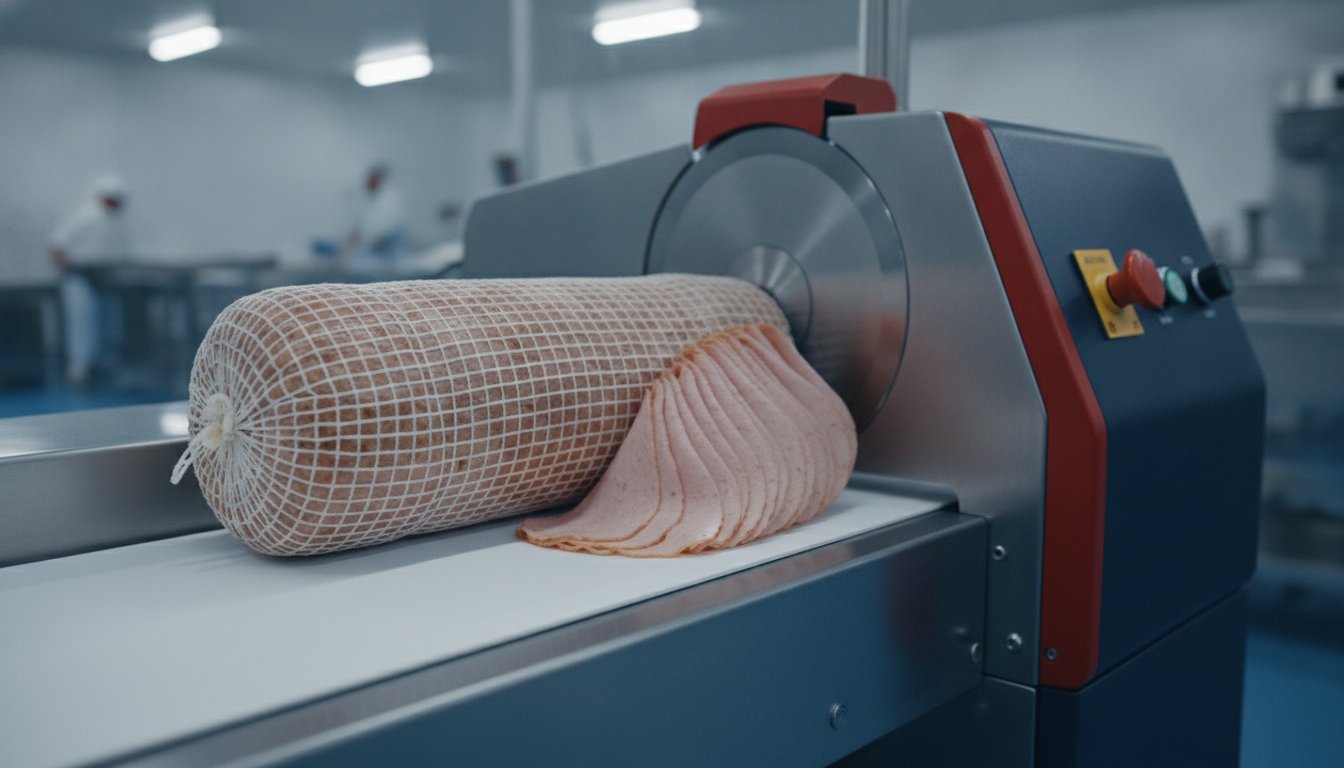
Every millimetre of diameter variation represents a direct loss in processing margin that many industrial facilities mistakenly accept as an unavoidable operational cost. The vast difference between the cost of netting and the value of the meat product allows for significant investment in netting to optimise overall performance across cooking, stripping, cavity, and slicing yield. Utilising specialised meat netting for improved slicing ensures the product diameter remains consistent, directly addressing weight variations at the slicing stage of production. You're likely familiar with the operational bottlenecks caused by netting adhesion or inconsistent density, which lead to significant yield loss during the stripping stage.
This guide provides a technical framework for optimising slicing yields through precise netting selection and automated processing techniques. You'll discover how the synergy between high-tension elastic recovery and controlled stuffing pressure reduces product tapering and minimises secondary waste. We'll examine the role of DS1200 series machinery in achieving uniform density. This article provides the technical insights needed to increase your premium slice count while improving overall production efficiency.
Key Takeaways
- Analyse the mechanical correlation between radial netting compression and internal product density to minimise slicing machine downtime.
- Implement a technical calibration protocol for selecting meat netting to improve slicing based on precise target diameters and protein-binding characteristics.
- Identify methods to significantly reduce "end-piece" waste by maintaining uniform product shape throughout the entire length of the joint.
- Evaluate the role of the DS1200 series in automating the stuffing process to eliminate the tension variability inherent in manual operations.
- Improve stripping efficiency and reduce product surface damage by utilising performance-grade netting tailored for industrial slicing applications.
Optimising Slicing Yield: The Physics of Product Uniformity
In secondary food processing, slicing yield is affected by the accuracy of the cooked log diameter. High-speed slicers require a precise level of internal product density, which can be affected by factors such as cavities and the finished diameter, to achieve a consistent slice weight. Specialised performance meat netting for improved slicing provides the necessary tension to eliminate internal voids and ensure a consistent density profile across the entire joint.
Uniform product diameter is the primary factor in improving sliced weight consistency. When a product diameter fluctuates, the slicer's sensors may register errors or produce off-weight slices that require manual rework. In large-scale ham and turkey production, even a 1% increase in slicing yield results in substantial annual revenue gain. Performance Netting is defined by its ability to maintain constant pressure throughout the cooking and cooling cycles, ensuring the product remains within the tight tolerances required by automated slicing lines.
The Impact of Tapering on Centre Slice Counts
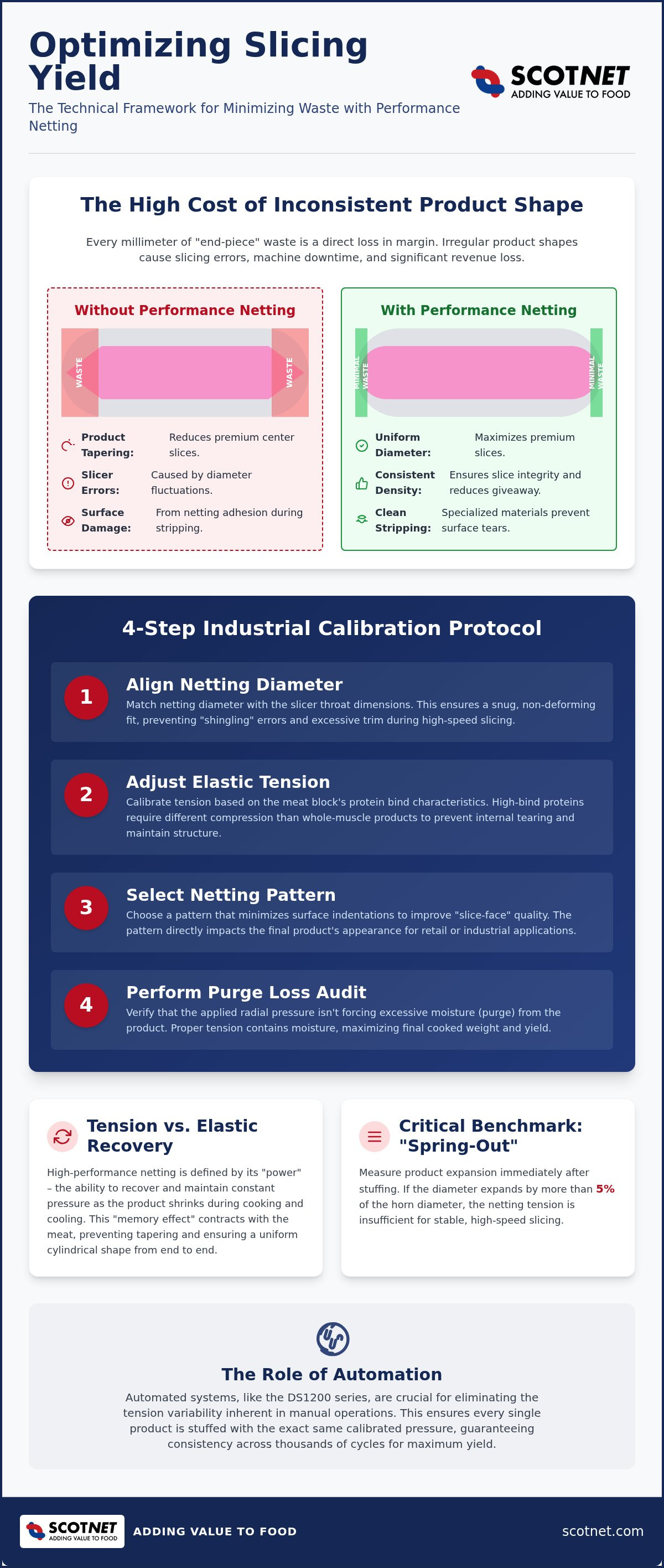
Irregular product ends, or tapering, typically occur during the cooking and cooling phase as proteins denature and moisture migrates. Without adequate containment, the meat expands at the centre and thins at the extremities. High-recovery elastic netting provides a continuous "memory" effect, contracting alongside the meat as it cools. This mechanical action maintains a cylindrical shape from the stuffing horn or tube to the slicing blade, increasing the number of premium centre slices available from every joint.
Stripping Efficiency: The Prerequisite for Clean Slicing
The efficiency of stripping fundamentally limits slicing performance. If netting adheres to the meat surface during removal, it causes surface tearing and "scarring" that renders the outer slices less valuable. Maintaining surface integrity is essential in high-speed applications, where every tear represents a potential downgrade. Learn more about our Performance Netting solutions to see how tailored elasticity improves both stripping speed and surface quality.
How to Select and Calibrate Meat Netting for Maximum Slicing Yield
Achieving the highest possible yield requires a systematic approach to netting calibration. Processors must first determine the precise target diameter of the finished product relative to the slicing machine aperture. A mismatch here leads to "shingling" errors or excessive trim. Selecting the correct power level is equally vital; high-bind proteins require different tension than whole-muscle products to prevent internal tearing. Understanding the factors that affect meat sliceability, such as temperature and muscle texture, allows for more accurate tension settings during the stuffing phase.
Calibration follows a four-step industrial protocol:
- Step 1: Align netting diameter with pack dimensions.
- Step 2: Adjust elastic tension based on the specific meat block's protein extraction levels.
- Step 3: Select a netting pattern that minimises surface indentations.
- Step 4: Perform a purge or cooking loss audit to verify that radial pressure isn't forcing excessive moisture out of the product.
Implementing specialised meat netting to improve slicing ensures that these parameters remain consistent over thousands of cycles. It's not just about the initial fit; it's about how the material reacts under thermal stress.
Evaluating Netting Tension and Elastic Recovery
There's a functional difference between initial stretch and "power": the netting's ability to recover during the thermal process. High-performance netting maintains constant pressure as the product shrinks during cooking.
Pattern Selection for Retail vs Industrial Slicing
The choice of pattern directly impacts the "slice-face" quality. For industrial applications where yield is the priority, "Smooth" or tight-weave netting is often preferred. These variants minimise deep surface grooves that can cause slice fragmentation. Technical analysis of The Role of Elastic Netting in Meat Processing Consistency shows how pattern selection influences the final presentation. Choosing the right pattern increases the potential that every slice meets retail specifications.
Integrating Automation to Enhance Netting Performance
Manual stuffing operations introduce human variability into the production line. This inconsistency directly affects the consistency of the finished product, which can cause fluctuations in its diameter. For facilities utilising meat netting, automation is the only method to ensure every joint meets the mechanical requirements of high-speed slicers. The DS1200PXP series applies pressure to the joint before netting, reducing loose ends and air pockets common in manual processes.
Technical features of the DS1200 series include:
- Automatic Piston Hold (APH): Maintains constant pressure on the meat block until the netting is secured, preventing internal expansion and tapering.
- Selectable Stroke Length (SSL): Allows operators to specify exact product lengths for precise programming of slicing machines.
- Tool-Free Changeovers: Ensure hygiene standards are met while enabling tool-free cleaning and rapid changeovers.
These features optimise product shape and minimise downtime during maintenance cycles. By standardising the stuffing pressure, processors ensure that the meat netting for improved slicing performs as intended throughout the entire production run.
Maximising Throughput with Double Stuffer Technology
The DS1200P8XP Double Press represents the industrial standard for high-volume lines, capable of achieving more than 1,000 netted joints per hour. By automating the stuffing and netting application, processors can double their throughput while maintaining consistent tension across every unit. This transition from manual labour to automated systems significantly reduces the risk of repetitive strain injuries and ensures a more predictable production schedule.
ROI and Long-Term Yield Gains
Investing in automated stuffing technology typically delivers an ROI in under twelve months for double-stuffer configurations. These gains are realised through a combination of reduced operator costs and a higher percentage of premium centre slices. Modern systems also feature remote diagnostics and cloud-based monitoring to track performance in real-time. For a broader perspective on how industrial packaging solutions impact overall costs, refer to our analysis on Global Bone Protection Manufacturer: Industrial Solutions Reducing Packaging Weight. Continuous line optimisation ensures that every component of the secondary processing environment contributes to maximum yield.
Advancing Production Standards Through Integrated Slicing Solutions
Achieving maximum yield requires a deliberate alignment of radial compression, product density, and automated stuffing precision. By selecting specialised meat netting for improved slicing, processors eliminate the variability associated with manual application and reduce the volume of unmarketable end pieces. This technical approach ensures that every joint maintains the structural integrity required for high-speed slicing environments, directly impacting the final margin per unit.
The design of the DS1200P8XP series provides the mechanical consistency required to achieve over 1,000 joints per hour. These systems are designed for rapid ROI; double-stuffer configurations typically pay for themselves in under twelve months through labour reduction and yield gains. Combining tailored netting with precision automation transforms the slicing line into a predictable, high-performance asset. Optimise your slicing yield with Scotnet's advanced netting and automation solutions. Your facility's transition toward standardised, high-yield production starts with the right technical partner.
Frequently Asked Questions
How does meat netting affect the number of centre slices I can get?
Meat netting provides the radial compression necessary to eliminate product tapering at the joint ends. By maintaining a constant cylindrical shape from the stuffing tube or horn through the cooling cycle, the proportion of premium centre slices increases. This mechanical containment ensures that the entire length of the product remains within the slicing machine's optimal cutting zone, reducing the volume of unusable "end-piece" waste.
Can high-tension netting cause the meat to tear during slicing?
Tearing during the slicing phase is typically a result of poor stripping performance rather than the tension level itself. If netting adheres to the meat surface, it creates yield loss during stripping. Optimising the square or mesh pattern ensures a clean separation. This maintains the surface integrity required for high-speed blades to produce clean, consistent slices without structural damage.
What is the difference between elastic netting and non-elastic netting for slicing?
Elastic netting provides continuous recovery during the thermal process, contracting as the proteins denature and moisture migrates. This "memory" effect maintains internal product density, which is a prerequisite for high-speed slice integrity. Non-elastic variants lack this ability to contract, often resulting in loose netting and air pockets. These inconsistencies cause product deformation and diameter fluctuations, leading to frequent slicing machine errors.
How do I choose the right tube size for my netting to ensure consistent slicing?
Tube size selection must be calibrated to the product's target finished diameter and the slicing machine's aperture dimensions. A properly sized tube ensures the netting provides enough tension to stabilise the meat block without over-compressing and causing excessive purge or cooking loss.
Does the netting pattern affect the performance of high-speed slicing machines?
Netting patterns directly influence the surface topography of the finished joint. High-speed slicing machines perform most efficiently with "Smooth" or tight-weave patterns that minimise deep surface indentations. Utilising the correct meat netting for improved slicing can reduce the blade from catching on deep grooves. This reduces the risk of slice fragmentation and surface scarring, ensuring every slice meets the visual and weight specifications required for retail packaging.
What is the ROI of switching from manual stuffing to an automated double-stuffer?
Automated double-stuffer configurations, such as the DS1200PXP series, typically deliver an ROI in under twelve months. This rapid return is driven by the ability to process more than 1,000 netted joints per hour and by the elimination of the tension variability inherent in manual stuffing. Automation standardises product density and diameter, significantly reducing "giveaway" costs and labour requirements while increasing the total yield of premium centre slices.
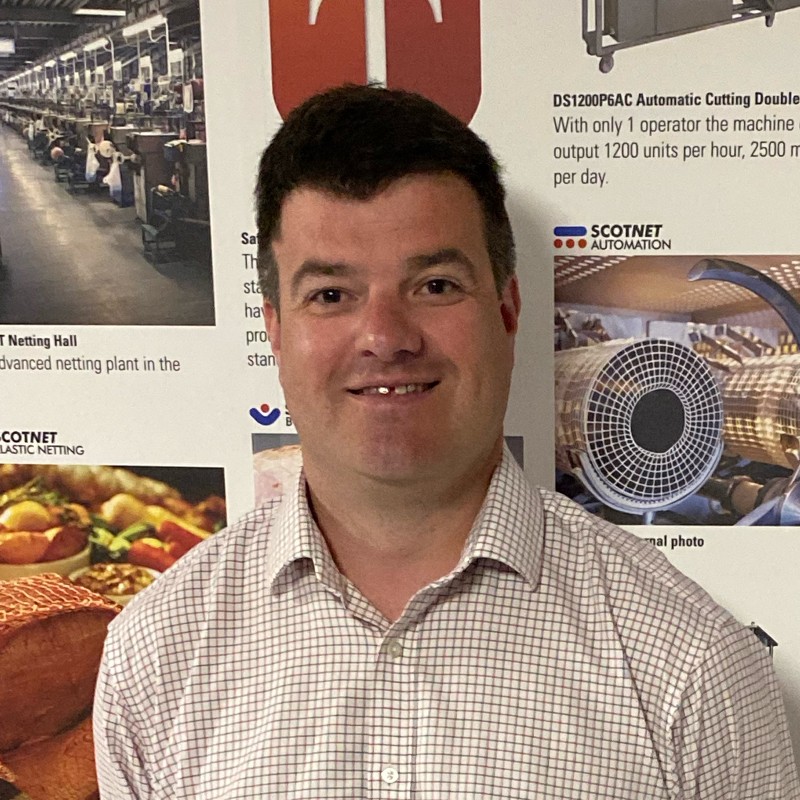
Article by
Gordon Wicklow
Gordon Wicklow is Managing Director of the Scobie & Junor Group, a family-owned Scottish business that has served the food and meat-processing industry for more than a century. A graduate of the University of St Andrews, Gordon has been a director of Scobie & Junor since 1998.
He leads the Group’s work across the UK and Ireland, helping food manufacturers add value through innovative ingredients, specialist packaging, elastic meat netting and automated processing machinery. Drawing on extensive industry experience and technical knowledge, Gordon champions practical innovation, operational efficiency and close customer collaboration—from developing new flavours and formulations to improving production yields, presentation and consistency.
Under his leadership, Scobie & Junor continues to combine more than 100 years of experience with modern manufacturing, new-product development and market insight, providing food processors and butchers with solutions designed for today’s evolving consumer and production demands.