ELASTIC NETTING
 AUTOMATION
 BONE PROTECTION

Netting Tension and Cooking Yield: Optimising Meat Processing Performance
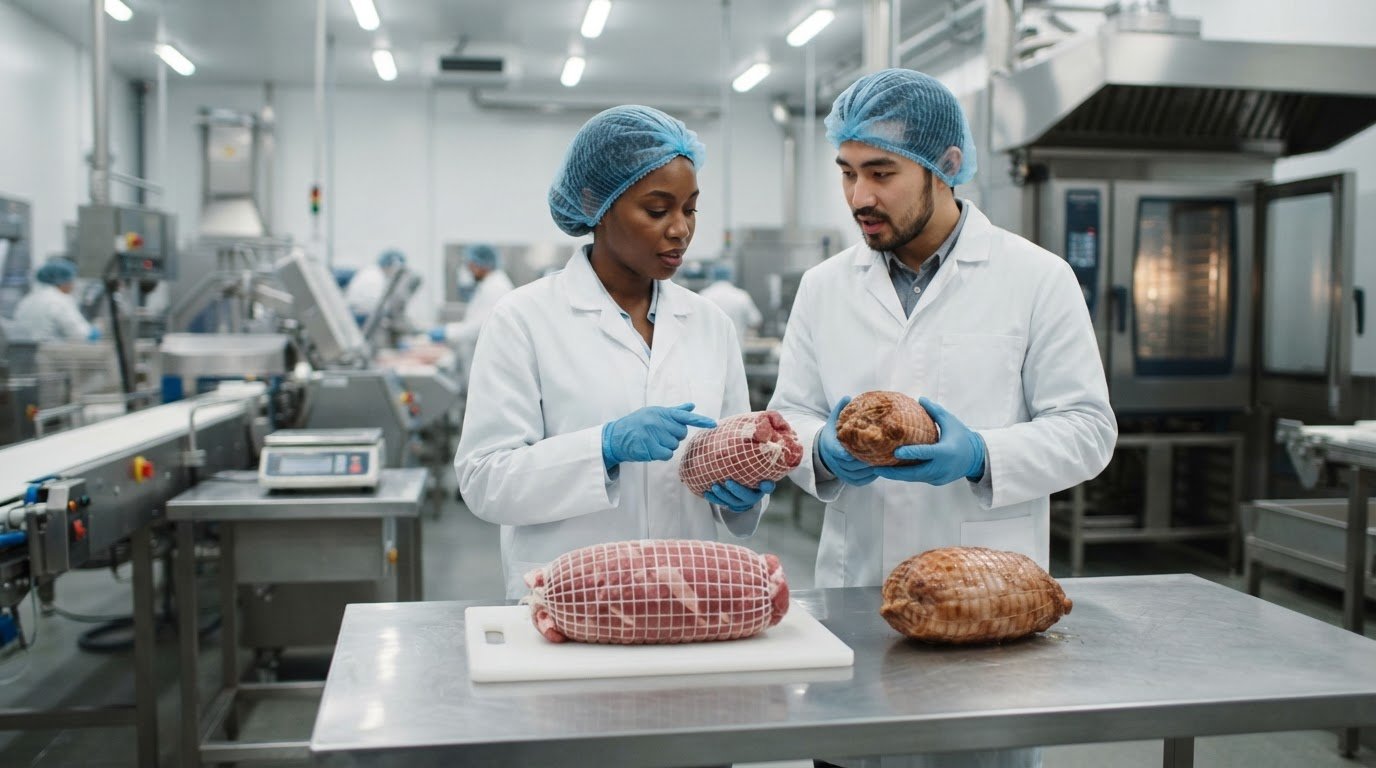
Several components come together in netting that can affect overall cooking yield. Of course, injection rates, temperature, humidity & cook time are all essential elements, but the netting itself is often overlooked. To understand it more completely, it helps to know what can be altered in the netting and how that can affect cooking yield: simply the percentage difference in weight before and after the cook.
Let's start with diameter. That's the size the netting is made to, and it is the maximum diameter the netting will stretch over a tube. The netting's elastic element only works over a limited stretch range, so it's an essential starting point to ensure the meat is snug in the tube and the net is designed for this tube size. Operators often prefer a looser net, as it loads and stuffs more easily; however, that can be to the detriment of the finished product.
Now, inserts. That's how tight the spirals are together along the length of the netting. The more spirals or inserts, the more inward pull the netting will have. During manufacture, we can control exactly how the rubber is fed in, and control the speed of the knitting head, thus altering the inserts.
Next is rubber thickness. We use three common thicknesses of rubber, the thickest being 24's, then 30's and finally 44's. The thicker the rubber, the more inward pull it has.
Now, finally, rubber strands. So we can knit with one, two or even three strands of rubber together in the net. The more strands, the more inward pull it has.
So, without introducing colour or altering the squares, that's 378 variations so far. Hopefully, it's clear that one net cannot be the answer for every joint.
Now, for cooking yield, it's a balance: the net must be tight enough to reduce cavities, but not so tight that it creates excessive cook loss.
At Scotnet, we have defined test procedures that we use to ensure testing is objective and accurate.
Key Takeaways
- Netting fit and specification can influence cooking performance, but tighter netting does not always mean better yield.
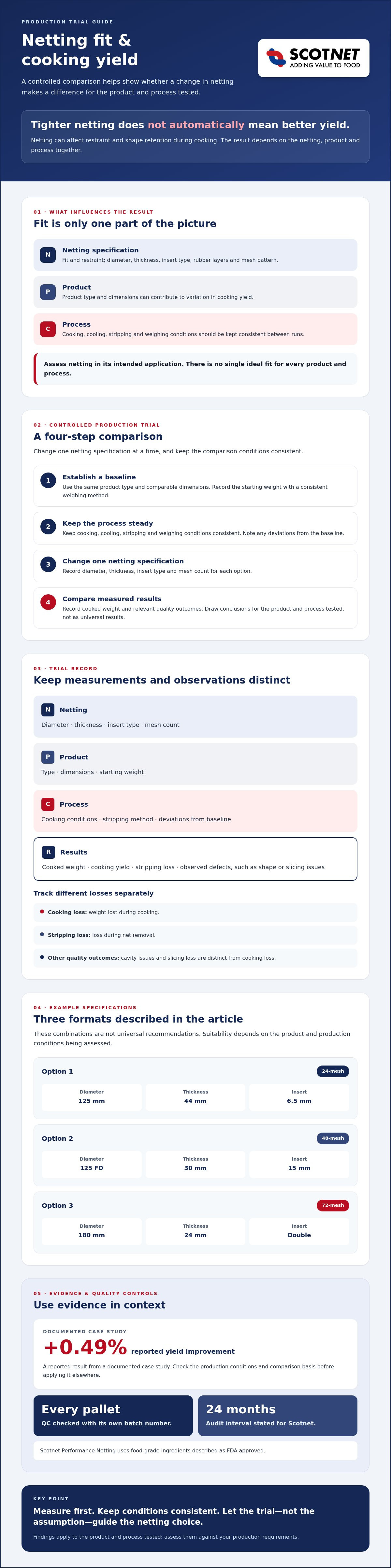
- Assess netting tension and cooking yield in a controlled trial. Establish a baseline, keep product and process conditions consistent, and change one specification at a time.
- Compare diameter, thickness, insert type and mesh count, then assess the results against your production requirements.
We are here to help set up the tests and will share useful tips for a successful comparison. Click to discuss your netting application with Scotnet. A carefully assessed trial is a practical next step towards a more consistent, evidence-led process.
Frequently Asked Questions
How does netting tension affect cooking yield in meat products?
Netting tension affects the fit and restraint around the product, which may influence shape retention and cooking loss. The result depends on how the specification matches the product and process, including product dimensions, cooking conditions and handling. There is no universal tension setting that guarantees improved yield, so assess the effect under consistent production conditions.
Can changing netting specifications reduce cooking loss?
A specification change may reduce cooking loss if it better suits the product and process, but improvement is not guaranteed. Review diameter, thickness, insert type and mesh count in relation to the loss being assessed. Measure cooking loss separately from stripping or slicing loss, and compare results in a controlled trial before adopting a change.
How should a processor measure cooking yield during a netting trial?
Record each product’s weight before cooking and after cooking under consistent weighing conditions. Calculate cooking yield as cooked weight divided by pre-cook weight, multiplied by 100. Keep the product, cooking conditions and handling consistent, and record stripping separately. Change one netting specification at a time so other process differences do not obscure the comparison.
What netting specifications can be tailored for different meat products?
Specifications can include diameter, thickness, insert type and mesh count; rubber layers and mesh pattern are also relevant to the design. Documented formats include 125 mm diameter, 44 mm thickness, 6.5 mm insert and 24-mesh; 125 FD diameter, 30 mm thickness, 15 mm insert and 48-mesh; and 180 mm diameter, 24 mm thickness, double insert and 72-mesh. Assess suitability for the product and process.

Article by
Gordon Wicklow
Gordon Wicklow is Managing Director of the Scobie & Junor Group, a family-owned Scottish business that has served the food and meat-processing industry for more than a century. A graduate of the University of St Andrews, Gordon has been a director of Scobie & Junor since 1998.
He leads the Group’s work across the UK and Ireland, helping food manufacturers add value through innovative ingredients, specialist packaging, elastic meat netting and automated processing machinery. Drawing on extensive industry experience and technical knowledge, Gordon champions practical innovation, operational efficiency and close customer collaboration—from developing new flavours and formulations to improving production yields, presentation and consistency.
Under his leadership, Scobie & Junor continues to combine more than 100 years of experience with modern manufacturing, new-product development and market insight, providing food processors and butchers with solutions designed for today’s evolving consumer and production demands.