ELASTIC NETTING
 AUTOMATION
 BONE PROTECTION
Stuffing Machine Efficiency: Engineering High-Throughput Netting Lines
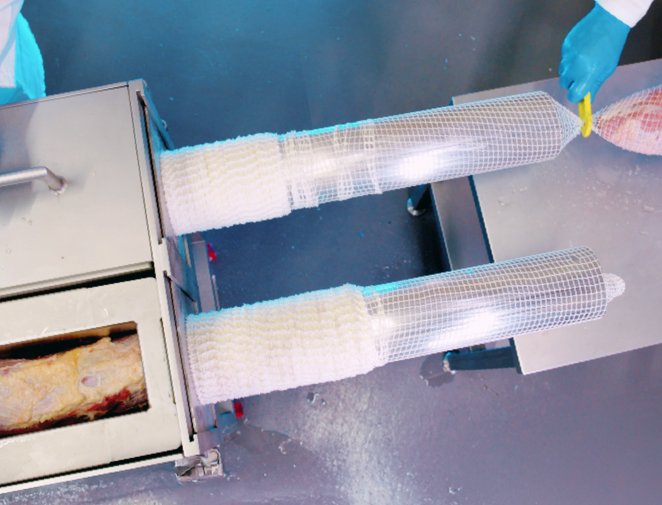
Maximising meat stuffing machine efficiency isn't simply about accelerating piston speeds; it's about eliminating mechanical dead time between cycles. Production managers are often surprised by how a team can look busy but not actually maximise output. Identifying what factors truly dictate line productivity requires looking past raw effort and examining the total cycle.
In this guide, you'll discover how advanced stuffing machine engineering, cycle optimisation, and automated pneumatic loading eliminate factory downtime to maximise hourly output. We'll break down the key mechanical drivers behind high-throughput net stuffing lines, showing how the small details add up to deliver true high-speed output over extended runs.
Key Takeaways
- Net stuffing machine efficiency depends on many factors, from the total quantity of netting on the tubes to the continuous output created by the nature of double stuffers.
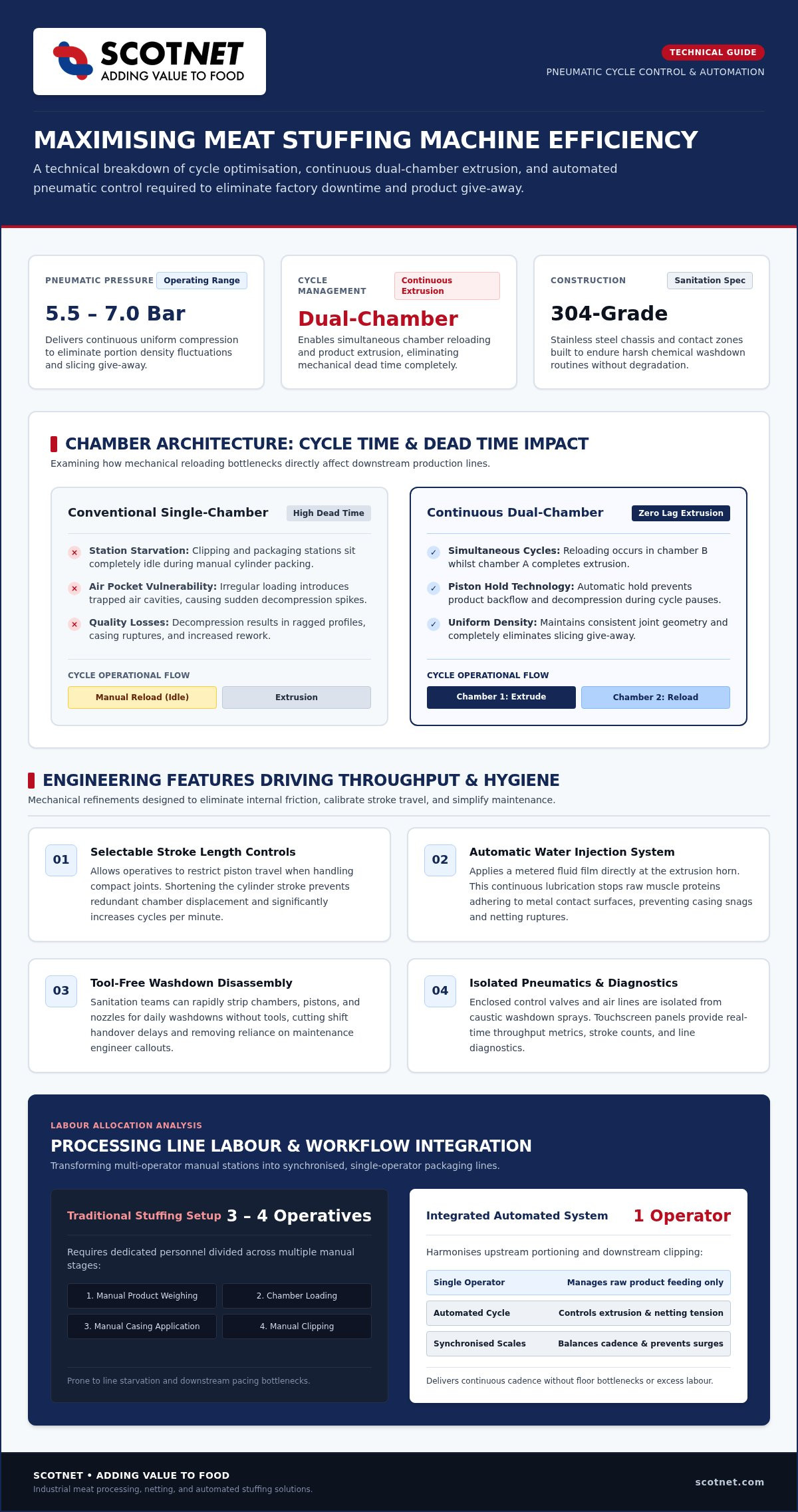
- Dual-chamber design and features like selectable stroke length eliminate mechanical dead time by enabling simultaneous chamber reloading and maximising operator output.
- Automated friction-reduction systems like automatic water injection prevent misshapen joints and product adhesion during high-speed netting cycles.
- Ensuring the total flow to the stuffing units and then working to get the netted product downstream to whatever happens next- portioning, clipping, injecting, and the like all add up to the total efficiency.
Cycle Time Friction and Chamber Reloading Delays
Conventional single-chamber stuffing systems inherently restrict factory output, as the machine spends half the total time resetting and returning the piston to its home position. During this time, the loading operator has to stop and wait. Equally, the cutting operator has to do the same. The double stuffer eliminates this, keeping the operators active at all times.
Pneumatic Control and Hygienic Washdown Architecture
Daily cleaning routines dictate operational availability. Tool-free chamber removal allows sanitation teams to strip chambers, pistons, and tubes, avoiding the need to the engineering teams to be present.
Frequently Asked Questions
How does a double stuffer improve meat stuffing machine efficiency compared to single units?
A double stuffer boosts meat stuffing machine efficiency by eliminating chamber reload lag through alternating parallel cylinders. While an operator reloads one chamber, the other side is resetting. This uninterrupted mechanical cycle enables throughput exceeding 1,200 netted joints per hour.
How do automatic water injection systems reduce downtime during industrial stuffing?
Automatic water injection systems spray a mist into the chamber area as a processing aid, ensuring dry products like pork slide smoothly through the system.
Can high-efficiency meat stuffing machines handle varied tube sizes without lengthy retooling?
Yes, our stuffing machines feature tool-free rapid tube and chamber changeovers across size changes. Standard setups accommodate tube diameters ranging from 75 mm to 200 mm, while extended-head variants support up to 250 mm. Line operators can swap and secure sizing tubes in minutes without specialist mechanical intervention, safeguarding shift flexibility.
Article by
Gordon Wicklow
Gordon Wicklow is Managing Director of the Scobie & Junor Group, a family-owned Scottish business that has served the food and meat-processing industry for more than a century. A graduate of the University of St Andrews, Gordon has been a director of Scobie & Junor since 1998.
He leads the Group’s work across the UK and Ireland, helping food manufacturers add value through innovative ingredients, specialist packaging, elastic meat netting and automated processing machinery. Drawing on extensive industry experience and technical knowledge, Gordon champions practical innovation, operational efficiency and close customer collaboration—from developing new flavours and formulations to improving production yields, presentation and consistency.
Under his leadership, Scobie & Junor continues to combine more than 100 years of experience with modern manufacturing, new-product development and market insight, providing food processors and butchers with solutions designed for today’s evolving consumer and production demands.