ELASTIC NETTING
 AUTOMATION
 BONE PROTECTION

Automatic Meat Netting Machine: Industrial Automation Guide & ROI Case Study
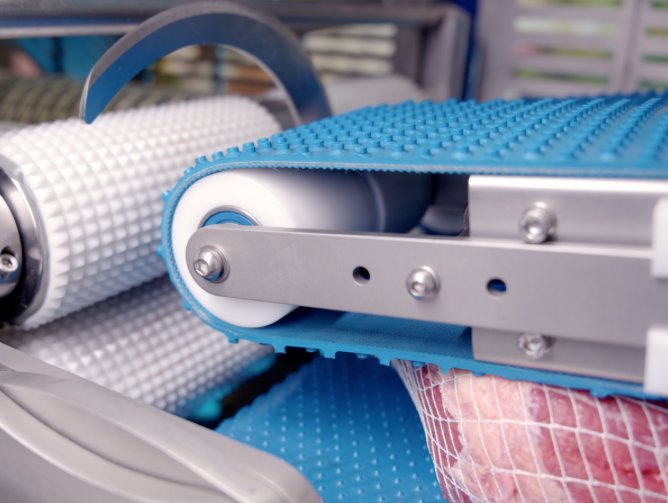
A manual packing line netting for example 1000 joints an hour will require approximately seven operators. This is no longer an operational standard; it's an expensive bottleneck. Meat processing facilities face persistent staffing shortages alongside rising wages, making high-volume packaging lines difficult to sustain manually. Integrating an automatic meat netting machine transforms this vulnerability by converting unpredictable manual labour into repeatable mechanical yield.
You already understand the daily operational cost of product springback, erratic netting tension, and excessive net waste. Discover how modern netting automation eliminates manual bottlenecks, slashes labour overheads, and delivers measurable packaging precision at over 1,000 units per hour, with a single operator. This guide examines the core engineering behind automated stuffing systems alongside a proven ROI case study detailing complete capital payback in under eight months.
Key Takeaways
- Identify the throughput ceilings, ergonomic strain, and high labour turnover inherent to manual meat stuffing systems.
- Discover how an automatic meat netting machines use precision optical sensors and bespoke roller systems to eliminate joint springback and netting waste.
- Analyse documented production line data showing how automated stuffing lines achieve sub-eight-month capital payback while reducing staffing from seven operators to one.
The Operational Limits of Manual Meat Stuffing and Netting
Manual netting systems establish an unyielding ceiling on industrial meat processing output. Muscle cuts forced through static tubes or horns rely entirely on operator stamina, generating erratic cycle rates that restrict upstream preparation lines. As daily production quotas scale, manual stuffing stations require unsustainable factory footprints and excessive labour, converting primary packaging halls into persistent operational bottlenecks.
Repetitive joint manipulation and sustained grip strain accelerate physical fatigue, driving costly operator turnover across multi-shift packing environments. Manual handling also introduces significant packaging material loss. Operators using shears or knives leave irregular netting tails typically ranging from 50 mm to over 100 mm. Over high annual throughput, these uneven cuts waste thousands of metres of elastic meat netting. Integrating a Scotnet Automation AC3 automatic meat netting machine dramatically reduces labour, and cutting tails to exact mechanical tolerances.
Key Engineering Standards in Automatic Meat Netting Systems
Mechanical control of whole-muscle joints has beed transformed by several unique features of our machinery.
- Centralising Rollers: Positioned before the stuffing aperture to centre the joint, guaranteeing square net alignment and dramatically reducing springback.
- Bespoke Pull Rollers: Actively grip and elongate whole muscles during advancement, preventing springout and maintaining uniform joint diameter.
- Autocut Precision Optical Sensors: Detect the trailing edge of meat joints dynamically, triggering pneumatic cutters to cut the netting near flush against the muscle face.
Case Study: Achieving Sub-8-Month ROI with the DS1200AC3
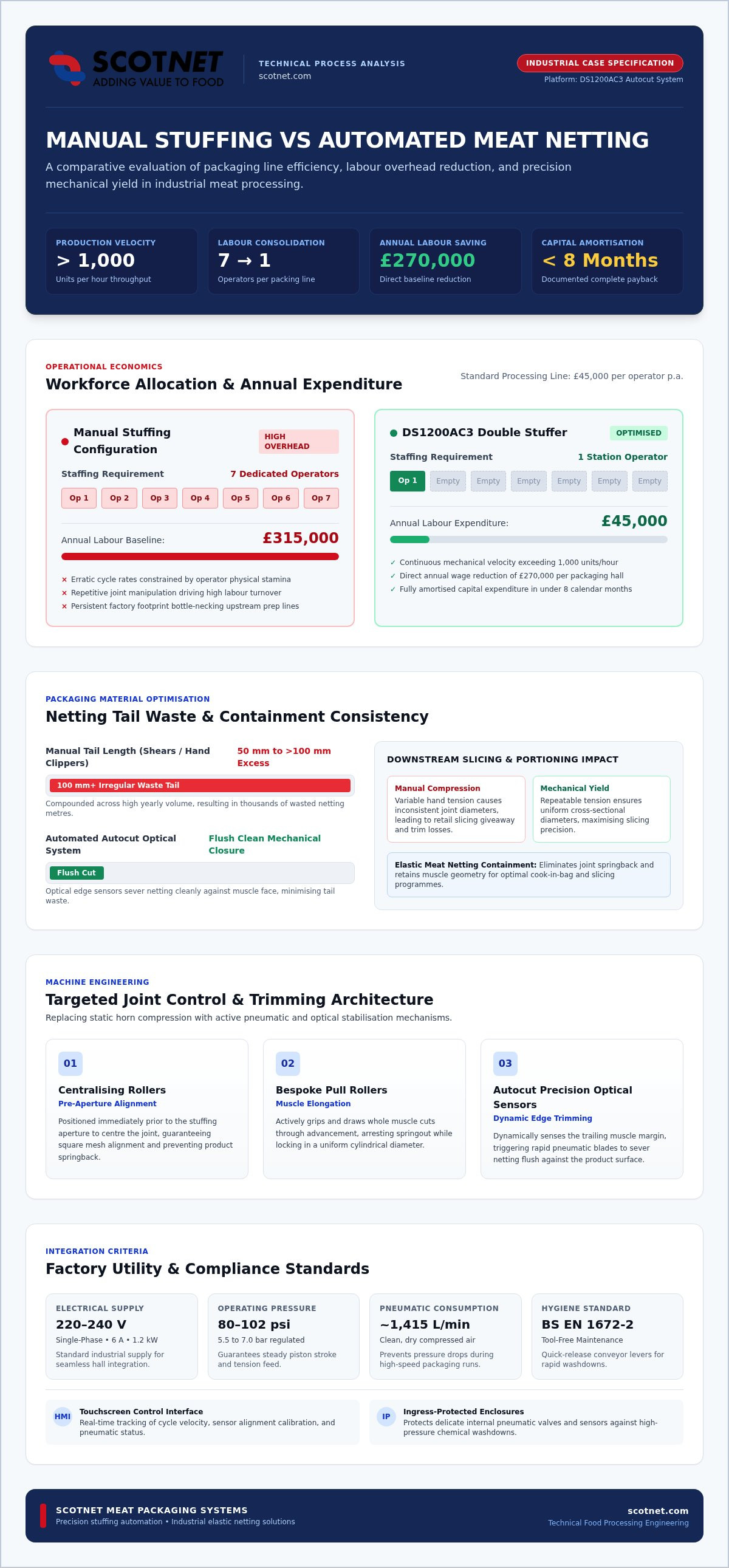
In a standard high-volume processing line, outputting for example 1000 joints per hour on a single 8 hour shift, requires typically seven dedicated manual operators, representing £315,000 in baseline annual labour costs based on £45,000 allocated per operator per annum. Transitioning to the DS1200AC3 Autocut Double Stuffer consolidated the entire operation down to a single station operator, lowering annual staffing expenditure to £45,000.
Operational capital recovery followed an accelerated path:
- Annual Direct Labour Reduction: £270,000 saved per annum.
- Netting Waste Reduction: Autocut sensor-guided trimming eliminated excess tail margins across every cycle.
- Capital Payback Period: Return on investment achieved in under eight months.
Processors achieve full capital recovery within the first year, transforming a vulnerable labour dependency into sustained line profitability.
Frequently Asked Questions
How many operators are required to run an automatic meat netting machine?
A fully automated Scotnet AC3 meat netting machine requires only a single operator to manage product feeding and line monitoring. In contrast to manual packing benches that often demand up to seven workers for positioning, netting and cutting. This single-station configuration maintains continuous throughput past 1,200 joints per hour while releasing plant personnel for upstream preparation.
What utility supplies are needed to operate an industrial automatic stuffer?
Industrial systems require standard electrical and pneumatic utility connections for continuous packaging runs. Machinery such as the DS1200AC3 operates on a 220–240 V, single-phase, 6 A electrical supply drawing 1.2 kW. Pneumatic requirements specify a regulated working air pressure between 80 and 102 psi (5.5 to 7 bar), with continuous air consumption of approximately 1,415 litres per minute to power automated cycling and trimming.
How does an automated meat netting machine eliminate product springback?
Springback is caused when multiple rubbers are cut when the primal is retailled into joints. This is created when the joint comes out of the tube in a non central position. The AC3 ensures the joint, even along its own length is always centrailised in the tube, applying the netting squarely.
What is the typical return on investment timeline for automated netting equipment?
Capital payback typically ranges between 8 and 11 months depending on operational volume and machine configuration. A double-stuffer automated line can generate documented annual labour savings of £270,000 by replacing multi-worker stuffing lines, recovering full capital outlay in under eight months. Even single-stuffer configurations delivering £180,000 in labour reductions regularly achieve full capital recovery within 11 months of continuous industrial operation.
Article by
Gordon Wicklow
Gordon Wicklow is Managing Director of the Scobie & Junor Group, a family-owned Scottish business that has served the food and meat-processing industry for more than a century. A graduate of the University of St Andrews, Gordon has been a director of Scobie & Junor since 1998.
He leads the Group’s work across the UK and Ireland, helping food manufacturers add value through innovative ingredients, specialist packaging, elastic meat netting and automated processing machinery. Drawing on extensive industry experience and technical knowledge, Gordon champions practical innovation, operational efficiency and close customer collaboration—from developing new flavours and formulations to improving production yields, presentation and consistency.
Under his leadership, Scobie & Junor continues to combine more than 100 years of experience with modern manufacturing, new-product development and market insight, providing food processors and butchers with solutions designed for today’s evolving consumer and production demands.