ELASTIC NETTING
 AUTOMATION
 BONE PROTECTION
How to Reduce Vacuum Pack Leakers: Debunking Industrial Packaging Myths
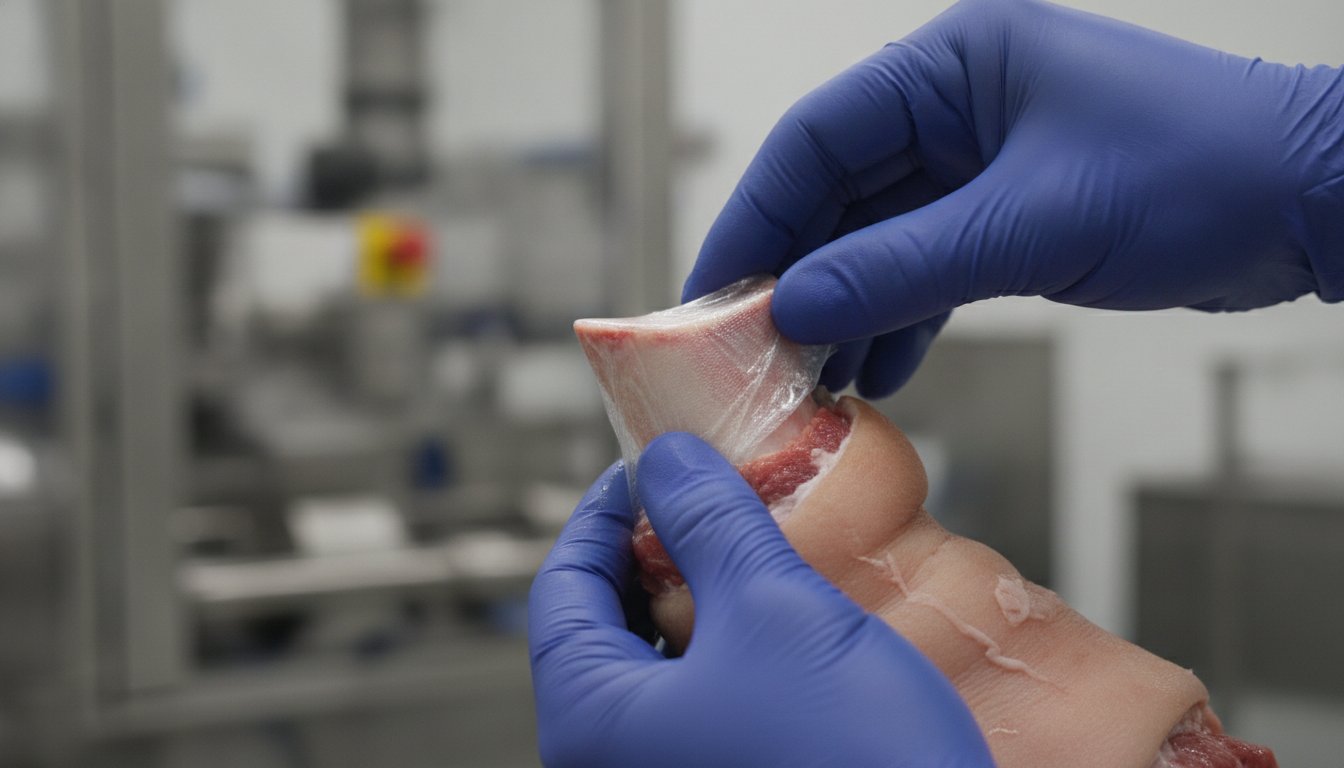
Why do your vacuum packs continue to leak despite maintaining perfect seal integrity on the production line? This's a common frustration for meat processors facing high product waste and costly retailer penalties. You've likely adjusted heat settings and vacuum times repeatedly, yet the "leakers" persist. The reality is that most failures aren't caused by poor seals; they're caused by mechanical punctures that traditional packaging fails to prevent.
This guide explains how to reduce vacuum pack leakers by shifting focus from the sealing process to bone protection. We'll debunk common industrial packaging myths and demonstrate how solutions like BG sheets, thermoformed caps and puncture-resistant packaging eliminate punctures at the source. You'll discover how switching to pre-formed Rack Caps can reduce packaging weight by 58%, helping lower your carbon footprint and address the UK Plastic Packaging Tax rate of £228.82 per tonne effective from April 2026.
Key Takeaways
- Distinguish between thermal seal integrity and mechanical puncture failure to identify the primary cause of industrial product loss.
- Identify the best solution for your application, from puncture-resistant bags, waxed cloth or thermal-formed protection.
- Improve operational margins by reducing waste, directly addressing rising environmental and regulatory costs.
Debunking the 'Bad Seal' Myth in Industrial Vacuum Packaging
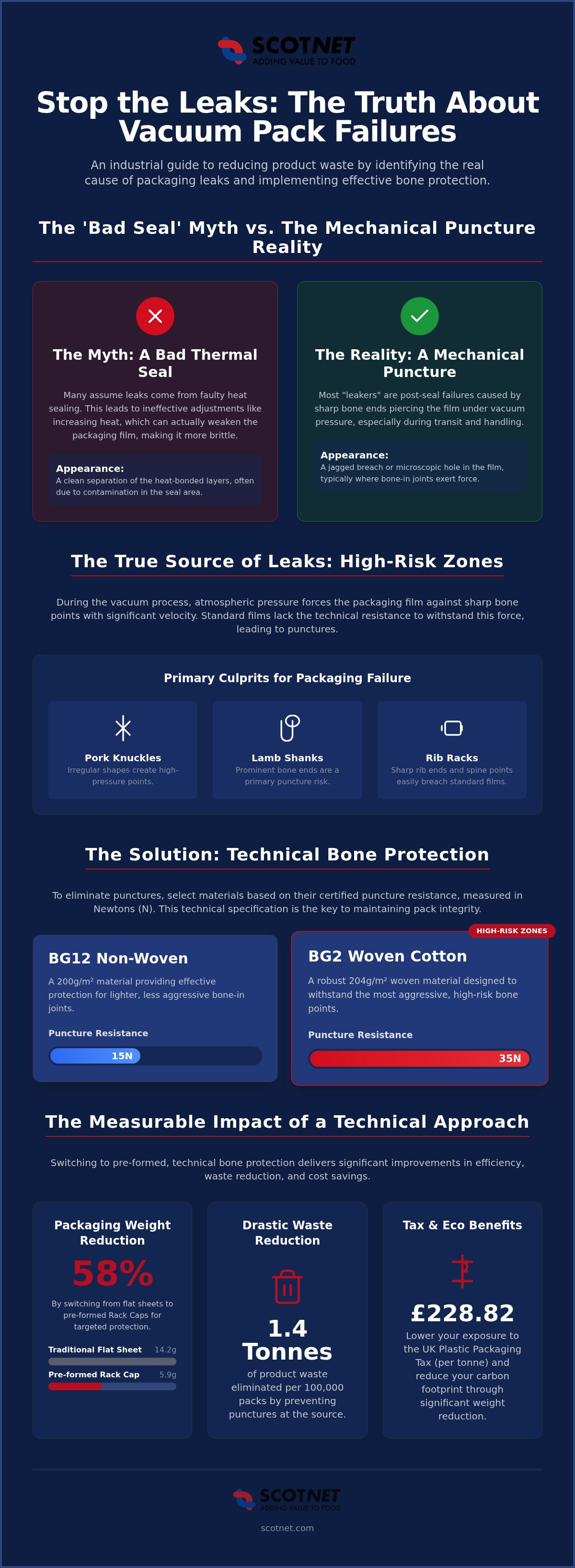
In industrial meat processing, a "leaker" is typically defined as a post-seal mechanical failure rather than a thermal-bond defect. While production teams often focus on seal integrity, most failures result from internal product friction. Standard Vacuum packing procedures effectively remove oxygen to extend shelf life, but the resulting atmospheric pressure forces the packaging film against sharp bone ends. A pack may appear hermetically sealed immediately after the cycle, yet microscopic punctures develop as the product moves through the cold chain.
Distinguishing between a seal failure and a material puncture is critical for those looking to reduce vacuum pack leakers effectively. A true seal failure presents as a clean separation of the heat-bonded layers, often caused by contamination in the seal area. Conversely, a mechanical puncture is characterised by a jagged breach in the film, typically located where bone-in joints exert the greatest force. It's a misunderstanding of the physics involved to attempt a fix by simply adjusting machine settings.
Why 'Turning Up the Heat' Fails to Reduce Leakers
Increasing seal bar temperature or dwell time is a common but flawed response to high waste rates. If leakers appear 24 to 48 hours post-pack, the machinery is rarely the root cause. Heat isn't the solution. Excessive heat degrades plastic polymers; it makes the film more brittle and susceptible to cracking under environmental stress. The 'puncture-leak' phenomenon occurs when sharp bone points pierce the packaging film during the high-pressure phase of vacuum contraction. To reduce vacuum pack leakers, processors must look beyond the seal bar and address the physical interaction between the bone and the film.
Identifying High-Risk Zones in Pork and Lamb Cuts
Pork knuckles, lamb shanks, and rib racks represent the highest risk for packaging failure. Rib ends and spine points are the main culprits for punctures because of their irregular, sharp profiles. While flat sheets offer protection, they can slip during high-speed production or packing. Pre-formed Shank Caps provide a superior alternative by offering targeted, immovable protection for these high-risk zones. These caps ensure that even the most aggressive bone points remain contained, maintaining pack integrity throughout the cold chain.
Balancing Puncture Resistance with Packaging Weight
Modern sustainability metrics require reducing total plastic and material use. Switching from traditional waxed cloth to pre-formed Rack Caps reduces packaging weight from 14.2g to 5.9g per unit. This 58% weight reduction saves 8.3g per pack. Scaled across a production run of 100,000 units, this equates to a 1.4 tonnes reduction in total waste. Adopting recyclable pre-formed caps for rib and bone ends helps processors reduce vacuum pack leakers while improving their environmental profile. For further technical insights, see our Bone Protection Packaging: Guide for Meat Processors.
Maintaining high safety standards while improving margins is achievable through precise bone protection. It's a strategic investment that safeguards your reputation with retailers and reduces environmental impact. Protect your product and your profits with Scotnet Bone Protection. Transitioning to technical bone protection ensures your production line remains efficient and your products reach the consumer in perfect condition.
Frequently Asked Questions
Why do my vacuum bags keep leaking after a few days?
Delayed leakage is typically caused by mechanical punctures from bone ends during vacuum contraction or transport vibration. Even if the seal integrity is perfect, internal tension forces the film against sharp points. This creates microscopic breaches that allow oxygen ingress over 24 to 48 hours. Implementing technical bone protection is the only reliable way to reduce vacuum pack leakers in these scenarios.
Is double bagging the best way to prevent bone punctures?
No, double bagging is an inefficient, costly method that fails to meet the technical requirement for puncture resistance. It doubles plastic consumption and labour costs without providing targeted protection.
What is the difference between BG12 and BG2 bone protection?
The main difference is material construction and puncture resistance. BG12 is a 200g/m² non-woven material offering 15N resistance, suitable for lighter joints. BG2 is a 204g/m² woven cotton material providing a higher 35N puncture resistance.
Can bone protection help reduce my company's carbon footprint?
Yes, technical bone protection directly improves sustainability metrics by reducing total packaging weight and product waste. Switching to pre-formed Rack Caps reduces packaging weight by approximately 58% compared to traditional waxed cloth. This equates to a reduction of 1.4 tonnes of waste per 100,000 packs. These measures help processors reduce vacuum pack leakers while lowering their liability under the UK Plastic Packaging Tax.

Article by
Gordon Wicklow
Gordon Wicklow is Managing Director of the Scobie & Junor Group, a family-owned Scottish business that has served the food and meat-processing industry for more than a century. A graduate of the University of St Andrews, Gordon has been a director of Scobie & Junor since 1998.
He leads the Group’s work across the UK and Ireland, helping food manufacturers add value through innovative ingredients, specialist packaging, elastic meat netting and automated processing machinery. Drawing on extensive industry experience and technical knowledge, Gordon champions practical innovation, operational efficiency and close customer collaboration—from developing new flavours and formulations to improving production yields, presentation and consistency.
Under his leadership, Scobie & Junor continues to combine more than 100 years of experience with modern manufacturing, new-product development and market insight, providing food processors and butchers with solutions designed for today’s evolving consumer and production demands.